
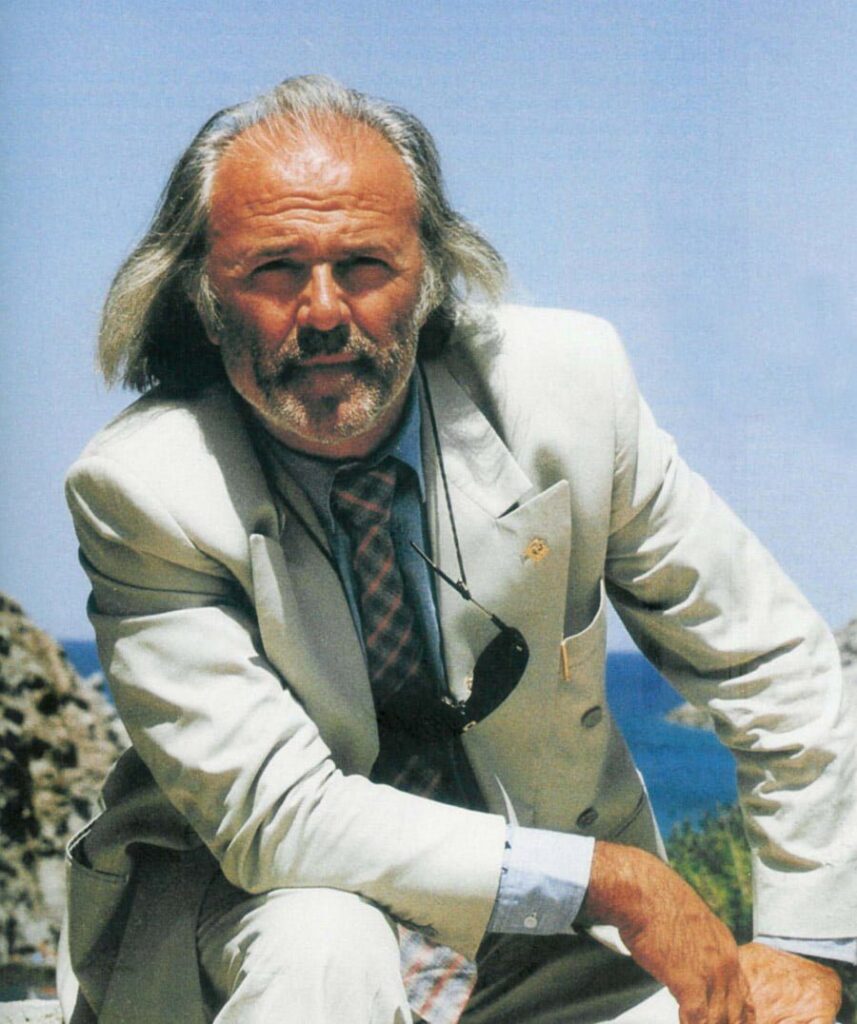
Antonio Meneghetti
How Antonio Meneghetti Discovered the Invisible Language Which Shapes Our Lives
About the Book
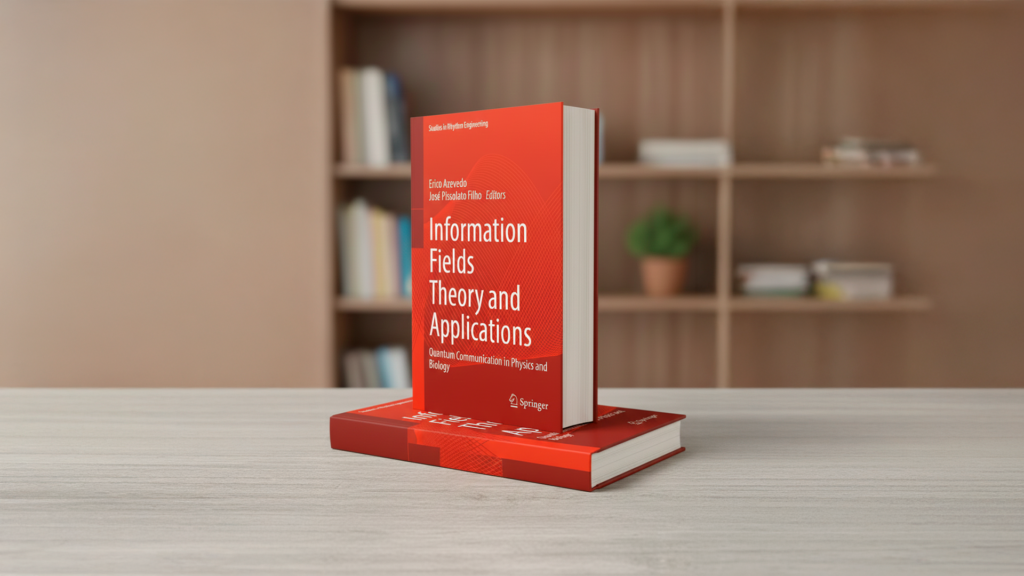
Information Fields: Theory and Applications (Springer Nature, 2026) is a landmark publication that establishes a new frontier in science. Edited by Erico Azevedo and José Pissolato Filho, this volume brings together 17 chapters from leading researchers around the world to explore how information—not just matter and energy—may be a fundamental building block of reality. The book bridges quantum physics, biology, and psychology, offering a unified framework for understanding how information organizes the universe, from entangled particles to human consciousness.
[Link to book: https://link.springer.com/book/9789819517411]
About the Author: A Renaissance Mind
Antonio Meneghetti (1936-2013) was one of those rare figures who defy easy categorization—a philosopher, psychologist, theologian, and artist whose work spanned disciplines and cultures. Founder of Ontopsychology, a comprehensive school of thought that integrates psychology, philosophy, and metaphysics, Meneghetti dedicated his life to understanding the deeper structures of human perception, communication, and being.
Born in Italy, Meneghetti’s intellectual journey took him from the Pontifical Lateran University in Rome (where he lectured on theology and philosophy) to the creation of Research Foundations in Italy, Switzerland and Brazil. He was a polymath in the Renaissance tradition—equally at home discussing quantum physics, classical philosophy, clinical psychology, and aesthetic theory.
The Three Discoveries of Ontopsychology
Meneghetti’s life work crystallized around three foundational insights:
- The Ontic In Sè — the authentic core of human identity, the “ontic in-itself” that precedes all cultural conditioning and psychological complexes. This is who we really are, beneath the masks.
- The Monitor of Deflection — the psychological mechanism that distorts authentic perception, introducing alien information into consciousness. This is the “virus” that makes us live lives not our own.
- The Semantic Field — the subject of this chapter: the unconscious information exchange that constantly flows between people, shaping emotions, behaviors, and even physical health.
Key Works by Antonio Meneghetti
- The Semantic Field (1976/2012): The foundational text presenting his third major discovery.
- The Ontic In Sè of Man (1981/2002): Explores the authentic core of human identity.
- The Monitor of Deflection (1985/2003): Identifies the mechanism that distorts authentic perception.
- Clinical Ontopsychology (1976/2006): Applies Ontopsychological principles to therapeutic practice.
- The Psychology of the Leader (2011): Extends these insights to social and organizational dynamics.
- Ontopsychology Handbook (2008): A practical guide to understanding and applying Ontopsychology.
About the Institution: Antonio Meneghetti Foundation
The Antonio Meneghetti Scientific and Humanistic Research Foundation (Switzerland) preserves, develops, and disseminates Meneghetti’s legacy, promoting research in Ontopsychology and its applications across psychology, philosophy, art, and social sciences. The Foundation also collaborates with Universities and Instituties, such as ORIONT in Brazil, ensuring that his vision continues to inspire new generations of researchers and practitioners.
The Central Idea: Nature Has Its Own Language
Imagine walking through a corridor lined with people. As you pass each person, you feel subtle shifts—a tightening in your chest, a relaxation in your shoulders, a sudden urge to turn back. These feelings seem to come from nowhere, yet they are unmistakable.
For Meneghetti, this is not imagination. It is perception of the semantic field—a continuous, unconscious information exchange that operates beneath all our conscious communication.
What is the Semantic Field?
Meneghetti defines it with characteristic precision:
The semantic field is the basic communication that nature establishes within its own individuations.
In simpler terms: nature, in creating separate individuals, also maintains a hidden network that connects them. Every living being constantly emits and receives information—not through words, not through gestures, not through any of the channels we normally study, but through a more fundamental layer of reality.
This information is not energy. It does not push or pull. It informs—it carries a pattern, a direction, an intention. And when it reaches a receiver, it modulates that receiver’s own energy, creating emotions, impulses, and even physical sensations that feel entirely personal but originate elsewhere.
The Gate Opener Analogy
Meneghetti’s most accessible illustration is beautifully simple:
Think of a small remote control that opens a heavy iron gate. The remote weighs grams; its battery could never generate enough energy to move tons of metal. Yet when you press the button, the gate opens. How?
The remote transmits information, not energy. That information triggers the gate’s motor, which applies its own energy to the task. The remote merely provides the pattern—the “open” command.
The semantic field works the same way. When someone near you is anxious, they don’t transmit anxiety-energy to you. They transmit the information of anxiety—a pattern—and your own body, receiving that pattern, generates the corresponding feeling. You experience it as your own anxiety, yet it originated elsewhere. This is why we can “catch” moods from others without knowing why. This is why walking into a room can feel tense or peaceful before anyone speaks. This is why, as Meneghetti puts it, “people constantly emanate intentions” —whether they know it or not, whether they want to or not.
Beyond Words: The Four Layers of Communication
Traditional communication theory recognizes three levels:
- Kinetic (K): Solitary body movements—scratching, crossing legs, fidgeting.
- Proxemic (P): Relational body language—how we position ourselves relative to others.
- Language (L): Words, grammar, the content of speech.
But beneath all these, Meneghetti identifies a fourth layer: the semantic field. This is the unconscious substrate that carries meaning not through symbols but through direct information transduction. When two people meet, two complete universes of meaning intersect. Their words may say one thing while their semantic fields broadcast another. A mother may tell her child “I want you to be happy,” while her semantic field transmits frustration, neediness, and expectation. The child feels the second message more deeply than the first—and lives it out, sometimes for a lifetime.
Positive and Negative Fields
The semantic field itself is neutral—like a newspaper, it carries information without judgment. Its effect depends entirely on how that information relates to the receiver: positive or negative are the effects.
Positive Semantic Field
When the information aligns with the receiver’s deepest nature—with what Meneghetti calls the “ontic In Sè”—it strengthens and nourishes. It feels like recognition, like coming home, like being seen. It activates vitality and growth. But even positive fields have a limitation: they work only for a time. If the receiver lacks inner integrity—if their consciousness is not aligned with their authentic self—the positive impulse will eventually be absorbed into old patterns. As Meneghetti puts it, give a thousand euros to someone accustomed to spending one euro on ice cream, and they will waste the thousand on more ice cream. The gift is not enough; the receiver must also be capable of receiving.
Negative Semantic Field
When the information is heterogeneous—foreign to the receiver’s authentic being—it introduces dissonance. The receiver experiences this as their own emotion, desire, or impulse, yet it originates elsewhere. They feel frustrated, depressed, aggressive, without knowing why. They invest 100 and receive 10. They live lives that are not their own.
This is not mysterious possession. It is a natural process with a specific mechanism:
- The informing emitter (I.E.) is in a state of need or frustration. Unconsciously, they broadcast their motivational drive.
- The executing receiver (E.R.) is open—through love, admiration, dependency, or simply being present. They receive the information and experience it as their own motivation.
- The receiver acts on this foreign impulse, believing they are following their own desire, while actually serving the emitter’s need.
For this to happen, the receiver must be predisposed in two ways:
- Complexual characteriality: They have a psychological structure—established in childhood—that makes them receptive to that specific kind of information.
- Openness: At the moment of reception, they are voluntarily, consciously, willingly receptive to the emitter.
The information then takes root. It may manifest immediately or lie dormant for years. It may express as emotion, as impulse, or as physical symptom—migraines, ulcers, cardiac distress. The receiver’s own energy executes the emitter’s intention.
Four Pathways of Transmission
Meneghetti maps four distinct ways semantic fields operate.
Direct Semantic Field
The simplest case: emitter and receiver are in direct contact. The receiver feels the emitter’s state as their own. A tense boss walks into the office, and within minutes everyone feels vaguely anxious. No one knows why.
Mediated Semantic Field
Information passes through a chain. A frustrated mother transmits her unmet needs to her daughter. The daughter, feeling this as her own drive, acts it out in relationships. The original emitter may never know—but her information lives on. Each mediator in the chain feels a vague tension, a sense of incompleteness, until they “pass on” the signal to the next receiver. None of them lives fully; all are conduits for information that originates elsewhere.
Trigger Effect Semantic Field
Information with delayed activation. A parent transmits a pattern to a child in infancy. For years, it remains dormant. Then, at puberty—or marriage, or career success—the pattern activates. The adult suddenly feels impulses, makes choices, lives out a script written long ago by someone now perhaps dead. This explains how family patterns perpetuate across generations without any conscious instruction. The child becomes the parent without knowing why.
Network-Effect Semantic Field
A whole system of individuals, each playing their part according to their own psychological structure, together produce an outcome that appears to be one person’s isolated action. A business fails; everyone blames the CEO. But the failure emerged from the network—from the interplay of many co-causes, each person contributing their piece. In such networks, each individual is a necessary link. Remove one, and the dynamic changes. But no single person is the cause. The cause is the field.
Why We Don’t Perceive Semantic Fields?
If this information exchange is constant and universal, why are we not aware of it?
Meneghetti’s answer is both simple and profound: we have never been taught to listen inward.
From childhood, our education focuses entirely on external learning. We learn to read the world, not ourselves. We absorb cultural patterns, logical structures, moral codes—all from outside. No one teaches us to attend to the subtle shifts in our own bodies, the wordless intuitions, the feelings that arise without apparent cause.
Two factors reinforce this blindness:
- Habit: We become comfortable with familiar patterns and mistake them for authentic existence. The stereotype feels like self.
- Laziness: It is easier to continue as we are than to develop new perceptions. We prefer the known, even when the known is not truly ours.
Beneath habit and laziness lies fear—fear of what we might discover, fear of change, fear of the responsibility that comes with genuine awareness. Yet the capacity to perceive semantic fields is not magical. It is a primary biological endowment, as natural as sight or hearing. We have simply let it atrophy through disuse.
Learning to Read the Field
The good news is: this capacity can be recovered. Meneghetti offers a practical path:
1. Reclaim the body as radar
The body registers every semantic interference. A tightening here, a relaxation there, a sudden impulse, an inexplicable mood. By learning to attend to these signals—with discipline and without judgment—we begin to distinguish what is ours from what comes from others.
This requires what Meneghetti calls “the greatest personal hygiene”—biological, psychological, moral. The cleaner the instrument, the more accurate the reading.
2. Cultivate aesthetic pleasure in daily life.
Beauty attunes us to truth. By surrounding ourselves with what is harmonious—in our environment, our relationships, our activities—we refine our sensitivity. The coarse cannot perceive the subtle.
3. Find a guide.
The semantic field, like any skill, can be taught. One learns by being with someone who already perceives, by having one’s attention directed, by receiving feedback. This is not mystery; it is apprenticeship.
As Meneghetti writes:
One’s own body is the ultimate radar of knowledge; it simply needs to be rediscovered. Once an individual regains this awareness, it will become natural to accurately perceive the intrinsic facts of human nature and to learn the infinite logical tactics of the mind, which will enable them to assess any situation with precision.
Clinical and Existential Implications
The semantic field is not an abstract theory. It has concrete consequences for health, relationships, and the quality of life.
Chronic exposure to heterogeneous semantic fields—fields that carry information foreign to our authentic being—produces predictable effects:
- Psychological distress: Depression, anxiety, meaninglessness, aggression
- Relational dysfunction: Repeated patterns of conflict, inability to sustain intimacy
- Somatic illness: Ulcers, heart conditions, tumors, autoimmune disorders
The schizophrenic, Meneghetti argues, is not primarily the product of genetics. The schizophrenic emerges through semantic communication from a frustrated or latent schizophrenic adult—usually a parent. The information is transmitted, received, and lived out.
This is not determinism. Awareness changes everything. Once we recognize a field as foreign, we can choose. We can accept or reject. We can become protagonists of our own lives rather than puppets of others’ intentions.
As Meneghetti puts it:
The defense from any kind of negative semantic field lies in a calm withdrawal into oneself, in a state of quiet inner recollection, because our psychic constitution is so strong that it cannot be altered by any external influence. Any form of external psychological aggression can only occur if the individual opens up from within.
The key always lies on the inner side.
Connections to Other Thinkers
Meneghetti’s semantic field resonates deeply with other contributors to this volume:
- Rupert Sheldrake’s morphic resonance describes how patterns are transmitted across species and time. The semantic field is morphic resonance operating in the human relational field.
- Dean Radin’s psi research provides experimental evidence for nonlocal information transfer. The ganzfeld telepathy results, the autonomic synchrony in Faraday cages—these are semantic fields measured.
- Erico Azevedo’s information field theory offers the mathematical framework that may one day describe semantic field dynamics. The nonlocal kernel $G(x,x’)$ could model how information transduces from emitter to receiver.
- Anirban Bandyopadhyay’s microtubule research suggests a physical substrate for semantic field reception—the body’s own quantum structures tuned to receive information.
Meneghetti’s work, developed independently and decades ago, now finds its place in a larger conversation about information as a fundamental layer of reality.
Why This Chapter Matters
The semantic field is not a curiosity. It is a key to understanding what it means to be human in a connected universe.
If Meneghetti is right, then:
- We are never truly alone. Our inner world is continuously shaped by information from others—whether we know it or not.
- We are constantly influencing others. Our intentions, our states, our unexpressed needs broadcast continuously. We are responsible for more than we know.
- Much of what we feel as “our own” may not be ours. The depression, the anxiety, the inexplicable attraction or aversion—these may be semantic fields we have received and mistaken for self.
- Freedom is possible. By learning to perceive fields, we can choose. We can accept what nourishes us and reject what does not. We can become authors of our own lives.
- Health depends on it. Chronic reception of heterogeneous fields produces disease. Learning to clear the field is not self-help; it is hygiene.
Final Thoughts
Reading Meneghetti’s chapter, one feels the presence of a mind that has seen deeply into human reality—and has the courage to name what it sees. His prose is direct, sometimes confrontational, always precise. He is not selling comfort; he is offering clarity.
The semantic field is not a metaphor. It is a discovery—a piece of reality that was always there but waiting to be named. Once named, it becomes accessible. Once accessible, it becomes usable.
As Meneghetti writes in his conclusion:
Knowing everything that happens is not a choice but a fact. If a person becomes conscious of it and learns to control it, all the better—because interaction occurs regardless.
We are always in conversation with the world. The only question is whether we will listen consciously—or remain asleep, living lives that are not our own.
Key Takeaways
- We broadcast continuously. Every person constantly emits information—intentions, states, needs—whether they know it or not.
- Information is not energy. Like a remote control opening a gate, the semantic field transmits only pattern; the receiver supplies the energy.
- Fields are neutral, effects are not. Information becomes positive or negative based on alignment with the receiver’s authentic being.
- We feel foreign impulses as our own. Information received through semantic fields is experienced as personal emotion, desire, or motivation.
- Transmission occurs through multiple pathways. Direct, mediated, trigger-effect, and network-effect fields explain how information propagates.
- The body is the radar. Reclaiming bodily awareness restores the natural capacity to perceive semantic fields.
- Perception can be learned. Reading semantic fields is a skill—teachable, trainable, available to anyone willing to cultivate inner awareness.
- Unconscious information shapes health. Chronic exposure to heterogeneous fields manifests as psychological distress and somatic illness.
About the Author’s Legacy
Antonio Meneghetti‘s work continues through the foundation that bears his name, through the universities he established, and through the researchers and practitioners he trained. His presence in this volume—decades after his first writings on the semantic field—testifies to the enduring power of his vision. Erico Azevedo, co-editor of this book and a direct disciple, carries Meneghetti’s legacy forward, integrating it with cutting-edge physics and experimental research. The conversation continues.
For Further Exploration
- Antonio Meneghetti Foundation: https://www.fondazionemeneghetti.ch
- Antoio Meneghetti Faculty (Brazil): https://www.faculdadeam.edu.br/
- Key Books:The Semantic Field, Clinical Ontopsychology, The Psychology of the Leader
Explore other Information Fields book chapters
Part I: The Physical Realm
Chapter 1: Information Fields as a Fundamental Physical Primitive
Erico Azevedo & José Pissolato Filho
Chapter 2: The Persistence of Information in a Quantum Reality
Shantena Sabbadini
Chapter 3: Unveiling Quantum Entanglement
Erico Azevedo & José Pissolato Filho
Chapter 4: Fractal Hyperspace Engineering
Anirban Bandyopadhyay, Sudeshna Pramanik & Pushpendra Singh
Part II: The Biophysical Realm
Chapter 5: Long-Distance Cellular Communication: A Review
Mariana Cabral Schveitzer & Maria Luiza Bazzo
Chapter 6: Biofields and Bioenergy
Konstantin Korotkov
Chapter 7: Developmental Biology and Morphogenetic Fields
Ricardo Ghelman
Chapter 8: Imperfection as the Foundation of Life
Ivan V. Savelev, Michael M. Rempel, Oksana Polesskaya, Richard Alan Miller & Max Myakishev-Rempel
Part III: The Biopsychical Realm
Chapter 9: Morphic Resonance and Beyond
Rupert Sheldrake
Chapter 10: Semantic Fields
Antonio Meneghetti
Chapter 11: Nonlocal Experiences in a Quantum Reality
Dean Radin, Helané Wahbeh, Garret Yount, Thomas Brophy, Sitara Taddeo & Arnaud Delorme
Chapter 12: Nonlocal Human Communication: A Unified Framework via the Field
Erico Azevedo
Chapter 13: Exploring the Dimensions of Consciousness
Tommy Akira Goto
Part IV: Applications
Chapter 14: Information Fields in Psychology
Erico Azevedo & Nathália Perin
Chapter 15: Medical Systems and Integrative Health
Ricardo Ghelman, Caio S. Portella & José Ruguê Ribeiro Junior
Chapter 16: Intuition and Noise in Decision Making
Erico Azevedo
Chapter 17: From Metaphysics to Science
Alécio Vidor
About ORIONT
ORIONT is an institute dedicated to research, training, and practical applications of Ontopsychology and human potential development. Co-founded by Erico Azevedo and Nathália Perin, it serves as a bridge between rigorous scientific investigation and the lived experience of human development. Through research, publications, and training programs, ORIONT carries forward the vision of a science that includes the full depth of human experience. [Website: https://oriont.org]
Stay tuned for our ongoing series exploring each chapter of Information Fields in depth. Follow us for deep dives into the frontiers of consciousness research!
#AntonioMeneghetti #SemanticField #Ontopsychology #InformationFields #UnconsciousCommunication #SpringerNature #ORIONT #Consciousness #Psychosomatics #HumanPotential
Quantum Communication in Physics and Biology
Springer Nature © 2026