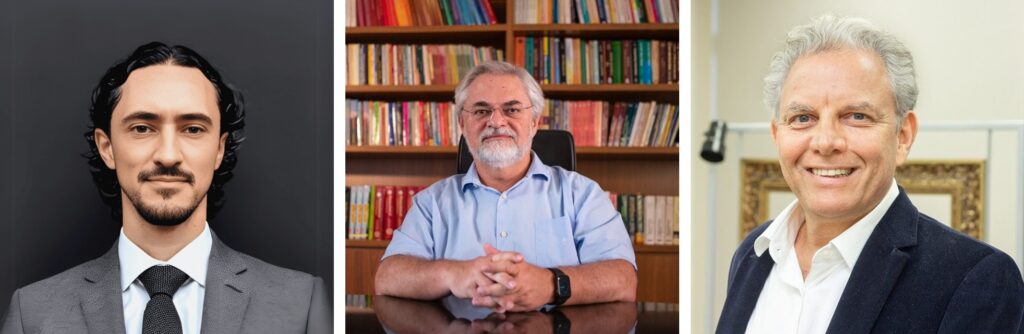
Ricardo Ghelman, Caio Portella & José Ruguê Ribeiro Júnior
How Three Brazilian Physicians Are Building a Bridge Between Ancient Wisdom and Modern Science
About the Book
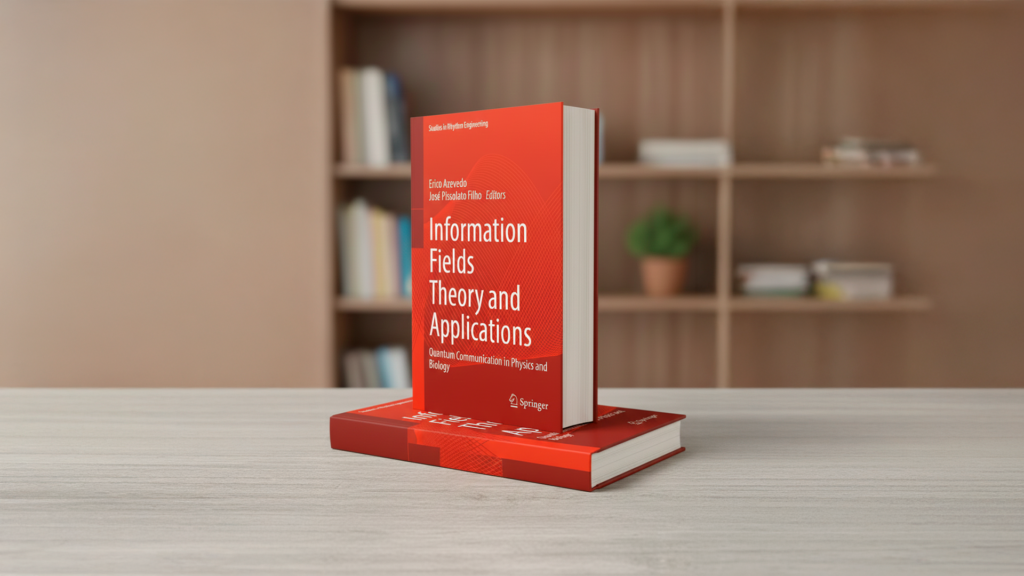
Information Fields: Theory and Applications (Springer Nature, 2026) is a landmark publication that establishes a new frontier in science. Edited by Erico Azevedo and José Pissolato Filho, this volume brings together 17 chapters from leading researchers around the world to explore how information—not just matter and energy—may be a fundamental building block of reality. The book bridges quantum physics, biology, and psychology, offering a unified framework for understanding how information organizes the universe, from entangled particles to human consciousness.
[Link to book: https://link.springer.com/book/9789819517411]
About the Authors: Three Physicians, One Vision
Ricardo Ghelman, MD, PhD, is a physician and researcher affiliated with the Brazilian Academic Consortium for Integrative Health (CABSIN) and the Federal University of Rio de Janeiro. His unique trajectory—medical doctor, developmental biologist, and integrative medicine researcher—positions him as a rare bridge-builder between conventional science and traditional medical systems. Readers of this volume already encountered his work in Chapter 7, where he explored how morphogenetic fields guide embryonic development. Here, he extends that vision to the whole of medicine.
Caio Fabio Schlechta Portella, MD, affiliated with CABSIN and the University of São Paulo (USP), brings deep expertise in Traditional Chinese Medicine. His work focuses on translating the ancient concepts of Qi, Yin-Yang, and the Five Elements into a language that modern science can engage with—without losing their original depth and wisdom.
José Ruguê Ribeiro Júnior, MD, affiliated with CABSIN and the Pontifical Catholic University of Rio Grande do Sul (PUC/RS), is a specialist in Anthroposophic Medicine—a Western integrative tradition that emerged in early 20th-century Europe. His contribution ensures that this chapter is truly global in scope, bringing together Eastern and Western approaches to healing.
Together, these three physicians represent what integrative medicine aspires to be: a genuine dialogue between traditions, grounded in clinical practice and open to scientific validation. Their chapter is not a dry academic exercise—it is a lived vision of what medicine can become.
About the Institution: CABSIN
The Brazilian Academic Consortium for Integrative Health (CABSIN) is a network of researchers, clinicians, and educators dedicated to advancing integrative and complementary medicine through rigorous science. It serves as a bridge between conventional medical institutions and traditional healing systems, fostering the kind of interdisciplinary dialogue that this chapter exemplifies.
The Big Picture: Medicine at a Crossroads
Medicine today stands at a crossroads—perhaps the most significant since the Scientific Revolution.
On one side stands the biomedical model, one of humanity’s greatest achievements. Its track record is undeniable: antibiotics that conquered infectious diseases, vaccines that eradicated smallpox, surgical techniques that repair the once-unrepairable, molecular therapies that target cancer with unprecedented precision. This model, rooted in the mechanistic worldview of Newton and Descartes, has saved countless lives and alleviated incalculable suffering.
But it has also revealed its limits.
Chronic diseases—the leading causes of death in the modern world—do not yield to simple fixes. The patient’s experience, their story, their suffering, their hope—these remain largely outside the model. The placebo effect demonstrates that meaning itself can heal, yet biomedicine has no framework for understanding how. And despite extraordinary technological advances, the epidemic of lifestyle-related diseases continues unabated.
On the other side stand the traditional medical systems—Ayurveda, Traditional Chinese Medicine, and other indigenous traditions that have sustained human health for millennia. These systems view health as balance, disease as disharmony, and healing as the restoration of wholeness. They speak of energies (Qi, Prana, Doshas), of fields and flows, of the irreducible interconnection between body, mind, spirit, and environment.
For most of modern history, these two worlds have been in conflict. Biomedicine dismissed traditional systems as primitive superstition. Traditional systems criticized biomedicine as reductionist and dehumanizing.
But something is changing.
The change is driven not by ideology but by science itself. Quantum physics reveals a universe of nonlocal connection, where particles remain entangled across any distance. Systems biology shows that health emerges from dynamic networks, not isolated components. Information theory demonstrates that pattern and meaning have physical reality. And now, information field theory () provides a framework that can hold both worlds: the precision of science and the depth of tradition, the measurable and the meaningful, the part and the whole.
As the authors write:
Beyond the dichotomy between vitalism and mechanism, between holism and reductionism, between the Indian, Chinese and European vision, there is the human and planetary phenomenon to be understood in its multidimensionality.
What Makes This Chapter Unique
What Ghelman, Portella, and Ribeiro Júnior have done is something rare: they have taken three major medical traditions—Ayurveda, Traditional Chinese Medicine, and Anthroposophic Medicine—and shown how each can be understood through the lens of information fields, without reducing any of them to mere “translations” of Western concepts.
This is not about proving that ancient traditions were “right all along” according to modern science. It is about recognizing that different cultures, at different times, developed sophisticated ways of understanding the same underlying reality: that living systems are organized by invisible fields of information, and that health depends on the coherence of these fields.
The chapter is structured as a series of dialogues:
- Ayurveda speaks of Doshas—three fundamental energies that govern all biological processes. The authors show how these can be understood as information fields, accessible through pulse diagnosis (Nadi Pariksha) and treatable through detoxification (Panchakarma), herbs, and lifestyle practices that restore field coherence.
- Traditional Chinese Medicine maps the flow of Qi through meridians—channels now shown to correspond to bioelectrical pathways in connective tissue. The dance of Yin and Yang, the cycles of the Five Elements—these are not metaphors but descriptions of dynamic informational patterns that modern science is only beginning to measure.
- Anthroposophic Medicine—the least known of the three in the English-speaking world—offers a uniquely Western integrative tradition, rooted in Goethe’s science and Rudolf Steiner’s philosophy. Its threefold organization of the human (neurosensory, rhythmic, metabolic-motor) and its four informational fields (mineral, vegetative, animal, human) provide a comprehensive framework for understanding health and disease that resonates deeply with the model.
What emerges is not a competition between traditions but a convergence. Each system, from its own cultural vantage point, has perceived aspects of the same reality. Together, they offer a more complete picture than any single tradition alone.
The Global Movement They Are Part Of
This is not just theoretical speculation. It is part of a global movement that is reshaping healthcare.
The World Health Organization (WHO) has expanded its terminology to include Traditional, Complementary, and Integrative Medicine (TCIM) , reflecting a growing global effort to incorporate these systems into national health policies. Between 1999 and 2018, the number of countries with national TCIM policies increased from 25 to 98.
In 1999, leading academic health centers in the United States formed the Academic Consortium for Integrative Medicine & Health, creating networks of researchers and professionals that have inspired similar initiatives worldwide—including the Dutch and Brazilian Academic Consortia.
In Brazil, the National Policy on Integrative and Complementary Practices was instituted in 2006, formalizing the inclusion of Traditional Chinese Medicine, Ayurveda, Anthroposophic Medicine, Naturopathy, Phytotherapy, and numerous therapeutic modalities into the national health system. It is now the most comprehensive TCIM policy in the world.
The authors are not isolated voices. They are part of a worldwide community of researchers, clinicians, and policymakers who recognize that the future of medicine requires integrating the best of all traditions.
What the Information Fields Framework Adds
Why is the framework important for this integration?
Because it provides a common language—a way of speaking about health and disease that can hold Ayurveda’s Doshas, TCM’s Qi, Anthroposophic Medicine’s morphogenetic fields, and biomedicine’s molecular pathways within a single conceptual framework.
In this framework:
- Doshas are information fields with specific frequencies and functions
- Qi is the flow of information through bioelectrical networks
- Meridians are the pathways along which this information travels
- Yin-Yang describes the dynamic equilibrium of complementary informational states
- Morphogenetic fields are the blueprints that organize biological form
- Disease is a disturbance in field coherence
- Healing is the restoration of coherence
This is not reductionism. It is not saying that Ayurveda is “really” about bioelectrical signals, or that TCM is “really” about systems biology. It is saying that all these traditions are describing aspects of the same underlying reality, and that by bringing them into dialogue, we can enrich our understanding of each.
Why This Chapter Matters
You might be wondering: why should I, as someone who is not a physician or researcher, care about this chapter?
Because the way we think about health shapes the way we experience it. If we believe the body is a machine, we will experience illness as mechanical breakdown and seek mechanical fixes. If we believe health is balance, we will attend to the patterns of our lives—diet, movement, relationships, meaning—in ways that prevent disease before it starts.
The traditions explored in this chapter offer something that biomedicine, for all its power, cannot provide: a language for the whole person. They speak to the experience of being alive—the ebb and flow of energy, the rhythms of the seasons, the connection between our emotions and our organs, the sense that our lives have meaning and purpose.
And they do this not as vague spirituality but as precise, clinically tested systems that have sustained human health for millennia. The framework adds something crucial: it shows that these traditions are not “alternative” in the sense of being opposed to science. They are complementary ways of understanding the same reality that science is now beginning to describe in its own language.
A Glimpse Inside: What You’ll Discover
Reading this chapter, you will encounter:
- The story of a cancer patient whose tumor, seen through the Anthroposophic lens, reveals a disturbance in the balance of four informational fields—mineral, vegetative, animal, human—and how treatment must address all four.
- The discovery that biphoton states—entangled photon pairs—exhibit interference patterns that precisely mirror the dynamic equilibrium of Yin and Yang, suggesting that quantum physics and ancient wisdom are describing the same reality.
- The finding that acupuncture meridians correspond to connective tissue planes with distinct electrical properties—high conductance, rapid signal propagation—providing a physical basis for the flow of Qi.
- The validation of Pfeiffer’s crystallization test, which can distinguish healthy individuals from those with cancer based on the patterns formed when blood is crystallized with copper chloride—a direct visualization of informational field states.
- The understanding of the menstrual cycle as a dance of four informational fields—vegetative (water), human (fire), animal (air), mineral (earth)—each phase requiring different kinds of support.
These are not abstract theories. They are clinically applicable insights that are already being used to help patients.
What This Means for the Future of Medicine
If the authors are right, the future of medicine will not be a choice between biomedicine and traditional systems. It will be an integration—a genuine synthesis that draws on the strengths of each.
Biomedicine will continue to excel at acute intervention: surgery for trauma, antibiotics for infection, targeted therapies for cancer. But it will be complemented by:
- Ayurvedic constitutional analysis to prevent disease before it starts
- TCM’s energetic mapping to detect imbalances at their earliest stages
- Anthroposophic biographical counseling to address the meaning and purpose dimensions of illness
- Information field diagnostics to visualize the state of the whole person
This is not a distant utopia. It is already happening in clinics and hospitals around the world, including in Brazil’s national health system. The chapter by Ghelman, Portella, and Ribeiro Júnior is both a report on this emerging reality and a roadmap for where it can go.
Key Takeaways
- Medicine is at a crossroads. The mechanistic model has reached its limits; traditional systems offer complementary wisdom.
- Three major traditions—Ayurveda, TCM, and Anthroposophic Medicine—all describe the same underlying reality: health as field coherence, disease as field disturbance.
- The framework provides a common language for integrating these traditions with modern science without reducing any of them.
- Ancient concepts are finding scientific validation: meridians as bioelectrical pathways, Yin-Yang as quantum complementarity, Doshas as information fields.
- Diagnosis can access fields directly through pulse reading, crystallization tests, and artistic expression analysis.
- Treatment is field recalibration—restoring coherence through diet, herbs, movement, art, and biographical work.
- This is not alternative medicine; it’s integrative medicine. A global movement, endorsed by the WHO and implemented in national health systems, is bringing these approaches into the mainstream.
- The ultimate goal is a medicine that treats the whole person—body, mind, spirit, and environment—with all the tools that human wisdom has developed.
About the Authors’ Journey
Ricardo Ghelman began his career studying embryonic development—how a single cell becomes a complex organism. This led him to morphogenetic fields, and from there to the realization that the same fields that shape the embryo continue to organize the adult body, and that their disturbance underlies disease.
Caio Portella was trained in conventional medicine but found that it could not answer his deepest questions about health and healing. His journey into Traditional Chinese Medicine revealed a sophisticated system that had been answering those questions for millennia—and his work now is to build bridges between the two worlds.
José Ruguê Ribeiro Júnior discovered Anthroposophic Medicine as a young physician and recognized in it a Western tradition that could hold both scientific rigor and spiritual depth. His decades of clinical practice have confirmed what the theory suggests: that treating the whole person requires addressing all dimensions of human existence. Together, they represent the best of integrative medicine: clinicians who know their traditions deeply, researchers who subject their practices to scientific scrutiny, and human beings who care about the people they treat.
For Further Exploration
- Brazilian Academic Consortium for Integrative Health (CABSIN): https://www.cabsin.org.br
- World Health Organization TCIM Strategy: https://www.who.int/health-topics/traditional-complementary-and-integrative-medicine
- Key concepts: Doshas, Qi, meridians, Yin-Yang, Five Elements, threefold organization, four informational fields, morphogenetic fields
Explore other Information Fields book chapters
Part I: The Physical Realm
Chapter 1: Information Fields as a Fundamental Physical Primitive
Erico Azevedo & José Pissolato Filho
Chapter 2: The Persistence of Information in a Quantum Reality
Shantena Sabbadini
Chapter 3: Unveiling Quantum Entanglement
Erico Azevedo & José Pissolato Filho
Chapter 4: Fractal Hyperspace Engineering
Anirban Bandyopadhyay, Sudeshna Pramanik & Pushpendra Singh
Part II: The Biophysical Realm
Chapter 5: Long-Distance Cellular Communication: A Review
Mariana Cabral Schveitzer & Maria Luiza Bazzo
Chapter 6: Biofields and Bioenergy
Konstantin Korotkov
Chapter 7: Developmental Biology and Morphogenetic Fields
Ricardo Ghelman
Chapter 8: Imperfection as the Foundation of Life
Ivan V. Savelev, Michael M. Rempel, Oksana Polesskaya, Richard Alan Miller & Max Myakishev-Rempel
Part III: The Biopsychical Realm
Chapter 9: Morphic Resonance and Beyond
Rupert Sheldrake
Chapter 10: Semantic Fields
Antonio Meneghetti
Chapter 11: Nonlocal Experiences in a Quantum Reality
Dean Radin, Helané Wahbeh, Garret Yount, Thomas Brophy, Sitara Taddeo & Arnaud Delorme
Chapter 12: Nonlocal Human Communication: A Unified Framework via the Field
Erico Azevedo
Chapter 13: Exploring the Dimensions of Consciousness
Tommy Akira Goto
Part IV: Applications
Chapter 14: Information Fields in Psychology
Erico Azevedo & Nathália Perin
Chapter 15: Medical Systems and Integrative Health
Ricardo Ghelman, Caio S. Portella & José Ruguê Ribeiro Junior
Chapter 16: Intuition and Noise in Decision Making
Erico Azevedo
Chapter 17: From Metaphysics to Science
Alécio Vidor
About ORIONT
ORIONT is an institute dedicated to research, training, and practical applications of Ontopsychology and human potential development. Co-founded by Erico Azevedo and Nathália Perin, it serves as a bridge between rigorous scientific investigation and the lived experience of human development. Through research, publications, and training programs, ORIONT carries forward the vision of a science that includes the full depth of human experience. [Website: https://oriont.org]
Stay tuned for our ongoing series exploring each chapter of Information Fields in depth. Follow us for deep dives into the frontiers of consciousness research!
#RicardoGhelman #CaioPortella #JoséRuguê #IntegrativeMedicine #Ayurveda #TraditionalChineseMedicine #AnthroposophicMedicine #InformationFields #SpringerNature #ORIONT #MorphogeneticFields #HolisticHealth #WHO #TCIM
Quantum Communication in Physics and Biology
Springer Nature © 2026