
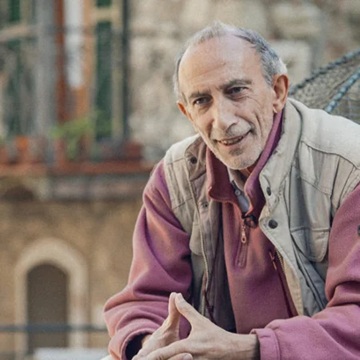
Shantena Augusto Sabbadini
How Shantena Sabbadini Bridges Quantum Physics and Eastern Wisdom to Solve the Measurement Paradox
About the Book
Information Fields: Theory and Applications (Springer Nature, 2026) is a landmark publication that establishes a new frontier in science. Edited by Erico Azevedo and José Pissolato Filho, this volume brings together 17 chapters from leading researchers around the world to explore how information—not just matter and energy—may be a fundamental building block of reality. The book bridges quantum physics, biology, and psychology, offering a unified framework for understanding how information organizes the universe, from entangled particles to human consciousness.
[Link to book: https://link.springer.com/book/9789819517411]
About the Author
Shantena Augusto Sabbadini, PhD, is a rare bridge-builder between two worlds that rarely meet: the rigorous mathematical universe of quantum physics and the contemplative wisdom of Eastern philosophy. A former particle physicist at the University of Milan and the University of California, Santa Barbara, Sabbadini later became a scholar of Taoism and Buddhism, translating the Tao Te Ching and I Ching into Italian, and serving for over two decades as a guide at the legendary Eranos Foundation in Switzerland—that unique intellectual crossroads where thinkers like Carl Jung, Mircea Eliade, and Henry Corbin explored the dialogue between science and spirituality. His journey from the frontiers of quantum mechanics to the depths of Taoist and Buddhist thought gives him a perspective that is both scientifically rigorous and philosophically profound—a voice that speaks to physicists and seekers alike.
About the Institution: Pari Center
The Pari Center, located in the medieval village of Pari in Tuscany, is a unique haven dedicated to fostering an interdisciplinary approach that links science, the arts, and the sacred. Celebrating its 25th anniversary in 2025, the Center provides a peaceful space for reflection and “gentle action” amidst a world of crisis and turmoil. Inspired by the work of thinkers like David Bohm and C.G. Jung, the not-for-profit organization hosts year-round residential conferences, courses, workshops, and online webinars. It also offers membership, which grants access to its quarterly journal, Pari Perspectives, and supports its mission to explore the wholeness of knowledge, community, ethical values, and the future direction of contemporary society.
About the Framework: Information Persistence
he quantum measurement problem has haunted physics for nearly a century: how does a system in superposition—existing in multiple states simultaneously—produce a single, definite outcome when measured? Schrödinger’s cat is both alive and dead until someone looks—but why?
Sabbadini’s framework offers a deceptively simple resolution: the wavefunction never collapses. It remains in superposition always. What changes is our access to information. When any physical record of the measurement outcome persists—whether in an apparatus, the environment, or an observer’s brain—the superposition becomes empirically indistinguishable from a classical mixture of definite states.
Key insights:
- No consciousness required: Unlike theories that place the observer at the center, a photon bouncing off the apparatus or an atomic vibration suffices. Consciousness plays no special role.
- Exact, not approximate: Unlike decoherence theory, which relies on environmental interactions to approximately suppress interference, this equivalence is mathematically exact.
- Scale independent: The proof holds for microscopic and macroscopic systems alike—from single photons to human brains.
- Reversible: When all records are erased (as in quantum eraser experiments), interference returns. The superposition was always there, merely hidden by information.
The Chapter in a Nutshell
Sabbadini opens with the fundamental tension at the heart of quantum mechanics. The equations tell us that after a measurement, the system and apparatus become entangled in a superposition—all possible outcomes coexist. Yet what we actually observe is a single, definite result. The standard “collapse” postulate simply declares that this happens, without explanation. For a century, physicists have struggled to reconcile these two descriptions.
The solution, Sabbadini argues, lies in recognizing that these two descriptions become empirically equivalent whenever any information about the measurement outcome persists. And in every practical measurement, information does persist—in the apparatus, in the environment, in our brains. That’s why we see definite outcomes.
What the Experiments Show
Two landmark experiments give striking support to this view:
Quantum Beats: When atoms decay through two indistinguishable paths, they produce interference patterns (“beats”). But if the final atomic state stores information about which path was taken—even if that information is never observed—the beats disappear completely. Mere existence of the record, not observation, destroys interference.
Quantum Eraser: In a specially designed interferometer, photons travel two possible paths. When “idler” photons record which path was taken, interference vanishes. But if those idler photons are later mixed together so the path information is erased, interference returns—even if the erasure happens after the original photons were detected. The system retroactively behaves as wave or particle based on whether information ultimately survives.
These experiments reveal a profound truth: quantum interference manifests only when no information about path exists. Any persistent record—observed or not—suppresses interference and enforces classical behavior.
The Mathematical Heart
For readers comfortable with a glimpse behind the curtain, Sabbadini’s proof extends the work of John von Neumann, one of quantum mechanics’ founders. Von Neumann showed that measurement involves a chain of interacting systems—the particle, the apparatus, the environment, the observer’s senses, the brain. Each link in this chain carries information about the outcome.
Sabbadini demonstrates mathematically that if any single link in this chain remains unperturbed—if any record of the outcome persists—then the superposition and the mixture become completely indistinguishable. All predictions match exactly.
The practical implication? By the time a measurement result reaches our consciousness, countless redundant records have propagated through the environment. We cannot perceive superposition because perception requires information persistence—the very condition that masks quantumness.
Reality, Contextual and Relational
Luc Montagnier’s experiments showed that DNA emits electromagnetic signals that can reconstruct nucleotide sequences in distant tubes—without chemical contact. Fritz-Albert Popp documented “biophotons” that coordinate cellular activity with astonishing precision. These are not energetic signals; they are informational signals, riding the phase gradients of . The energy comes from the receiving system; the information field merely provides the pattern.
The Biological Frontier: From Photosynthesis to Consciousness
Perhaps the most provocative implications lie in biology. Photosynthesis, for example, involves long-lived quantum coherence in the Fenna-Matthews-Olson complex. Vibrational modes in the surrounding protein act as temporary “apparatuses,” recording exciton paths. Sabbadini’s framework predicts that classical energy transport dominates precisely when these vibrational records become irreversible—a hypothesis testable with ultrafast spectroscopy.
Even more daring is the possible link to consciousness. Anirban Bandyopadhyay’s experiments on microtubules—the protein structures inside neurons—have shown:
- Quantum coherence at room temperature, with resonant vibrations persisting for hundreds of microseconds
- Electrodynamic activity suggestive of topological qubit encoding
- Microtubules as potential quantum measurement devices, where vibrations could act as persistent information channels, collapsing quantum superpositions into classical percepts
If verified, this would mean consciousness itself emerges from a delicate balance: microtubules must preserve information long enough to stabilize classical outputs (decisions, perceptions) but remain sufficiently coherent to enable quantum computation. The “persistence condition” suggests classical cognition arises when neuronal records—synaptic weights, neural firing patterns—redundantly encode quantum states.
Bridges to Other Theories
Sabbadini’s framework resonates with several major approaches in contemporary physics:
- De Broglie-Bohm theory also sees measurement outcomes encoded in physical configurations, though it treats the wavefunction differently.
- Quantum Darwinism shows how information proliferates into the environment, creating redundant copies accessible to multiple observers.
- Relational Quantum Mechanics treats states as observer-dependent, and Sabbadini’s work identifies the material basis of this relativity—the physical records themselves.
- Holographic theories like AdS/CFT suggest that information on a boundary encodes bulk reality, offering a cosmic-scale analogue.
Yet Sabbadini’s approach remains distinct: it requires no approximation, no special scale, no consciousness. Just information, physically instantiated.
Eastern Resonances: Taoism, Buddhism, and the Tao of Physics
What makes Sabbadini’s contribution unique is his ability to weave Eastern philosophical insights into the quantum measurement discussion—not as vague analogies, but as deep structural resonances.
Taoism and the Uncarved Block: The Tao Te Ching speaks of the uncarved block—undifferentiated potential from which all forms emerge. This resonates profoundly with the quantum superposition before measurement: pure potentiality, all possibilities coexisting. The measurement process “carves” the block, producing definite forms—yet the uncarved nature remains, accessible when all records are erased. The Tao that can be told is not the eternal Tao; the superposition that can be measured is not the eternal superposition.
Buddhist Emptiness and Dependent Origination: Buddhist philosophy teaches that phenomena lack inherent existence—they arise dependently, in relation to causes, conditions, and consciousness. Sabbadini’s framework echoes this perfectly: measurement outcomes are not absolutely real but gain reality contextually, based on information persistence. The superposition is empty of inherent definite states; outcomes emerge relationally. This is neither eternalism (things exist absolutely) nor nihilism (nothing exists)—it is the Middle Way.
Yin-Yang and Complementarity: The Taoist yin-yang symbol represents complementary opposites—wave and particle, potential and actual—not as contradictory but as mutually arising. Quantum complementarity finds ancient expression here. Interference (wave nature) and path information (particle nature) cannot simultaneously manifest—they are yin and yang of quantum reality, forever dancing.
The I Ching and Probability: The ancient Chinese “Book of Changes” treats reality as process, not substance. Hexagrams represent archetypal situations, not fixed states. This resonates with quantum probabilities as tendencies, not ignorance—and with the idea that measurement outcomes emerge from potential through relational dynamics. Sabbadini’s translations of these classics were not academic exercises; they were acts of deep listening across cultures. His physics and his philosophy speak the same language.
Why This Matters
The quantum measurement problem is not merely academic. It touches the deepest questions about the nature of reality, the relationship between mind and world, and the place of consciousness in the cosmos.
If Sabbadini is right—and the evidence from quantum eraser experiments strongly supports him—then:
- We don’t need to invoke consciousness to explain measurement. The observer is not a mystical collapser but the endpoint of a physical information chain.
- The classical world is not a fundamental layer of reality but an emergent phenomenon driven by information propagation. Beneath it, superposition always reigns.
- Reality is relational and contextual. What is real for one observer (with access to certain records) may not be real for another. This is not relativism but physics.
- The boundary between quantum and classical is not a size threshold but an information threshold. Large systems appear classical because they inevitably spawn redundant records.
- Life may exploit this boundary. Photosynthesis, and possibly consciousness, may operate at the edge where quantum coherence meets information record-formation.
A Unifying Vision
Sabbadini concludes with a vision that is both scientifically rigorous and philosophically expansive:
The implications ripple outward. At the subatomic level, the persistence of information in vacuum fluctuations or quark-gluon plasmas suggests that even in high-energy regimes, the classical world emerges through the same principles that govern laboratory measurements. In biological systems, the delicate balance between coherence and record-formation may underpin phenomena as diverse as photosynthesis and neural processing, hinting that life itself exploits the boundary between quantum and classical information dynamics.
If consciousness indeed arises from physical processes that preserve information in structured ways, then our very experience of a stable, classical world may be the consequence of our immersion in an endless von Neumann chain—perception as the endpoint of countless quantum measurements propagating through time and space.
This is not a reduction of the universe to mere information, but an elevation of information to its proper role: the connective tissue between quantum mechanics and lived experience.
In the end, the persistence of information is more than a technical condition for the quantum-to-classical transition. It is the thread that weaves together the fabric of reality, from the behavior of photons in an interferometer to the workings of the human mind. As we pull on this thread, we may find that the universe is not just described by quantum mechanics, but is quantum mechanics—all the way up, and all the way down.
Final Impressions
Reading Sabbadini’s chapter feels like watching a master weaver at work. Threads from von Neumann’s mathematics, experimental physics, quantum foundations, biology, Taoism, and Buddhism are woven into a coherent tapestry—each thread retaining its integrity, yet contributing to a larger pattern.
The result is not syncretism but synthesis: a vision of reality where information plays the role that matter played in classical physics and energy played in early quantum theory. Not as an abstraction, but as physical, causal, and relational. For readers new to these ideas, the chapter offers a clear entry point into one of physics’ deepest puzzles. For those already familiar, it provides a fresh perspective that connects dots rarely connected. And for anyone interested in the dialogue between science and spirituality, it demonstrates that this dialogue can be rigorous, informed, and profoundly illuminating.
Key Takeaways
- The measurement problem has a solution: Superpositions and mixtures become empirically indistinguishable whenever any physical record of the outcome persists.
- No collapse, no consciousness required: The wavefunction never collapses. Information persistence, not observation, explains definite outcomes.
- Experiments confirm it: Quantum beats and quantum eraser experiments show interference vanishes when path information exists—even if never observed—and returns when all records are erased.
- Reality is contextual: Properties gain “element of reality” status only relative to persistent records. Reality is relational, not absolute.
- Life exploits the boundary: Photosynthesis and possibly consciousness operate where quantum coherence meets information record-formation.
- Eastern wisdom resonates: Taoist and Buddhist insights—uncarved block, dependent origination, yin-yang—find deep structural parallels in quantum measurement theory.
- A unifying thread: The same principles govern quantum-to-classical transition across scales, from vacuum fluctuations to neural processing.
Explore other Information Fields book chapters
Part I: The Physical Realm
Chapter 1: Information Fields as a Fundamental Physical Primitive
Erico Azevedo & José Pissolato Filho
Chapter 2: The Persistence of Information in a Quantum Reality
Shantena Sabbadini
Chapter 3: Unveiling Quantum Entanglement
Erico Azevedo & José Pissolato Filho
Chapter 4: Fractal Hyperspace Engineering
Anirban Bandyopadhyay, Sudeshna Pramanik & Pushpendra Singh
Part II: The Biophysical Realm
Chapter 5: Long-Distance Cellular Communication: A Review
Mariana Cabral Schveitzer & Maria Luiza Bazzo
Chapter 6: Biofields and Bioenergy
Konstantin Korotkov
Chapter 7: Developmental Biology and Morphogenetic Fields
Ricardo Ghelman
Chapter 8: Imperfection as the Foundation of Life
Ivan V. Savelev, Michael M. Rempel, Oksana Polesskaya, Richard Alan Miller & Max Myakishev-Rempel
Part III: The Biopsychical Realm
Chapter 9: Morphic Resonance and Beyond
Rupert Sheldrake
Chapter 10: Semantic Fields
Antonio Meneghetti
Chapter 11: Nonlocal Experiences in a Quantum Reality
Dean Radin, Helané Wahbeh, Garret Yount, Thomas Brophy, Sitara Taddeo & Arnaud Delorme
Chapter 12: Nonlocal Human Communication: A Unified Framework via the Field
Erico Azevedo
Chapter 13: Exploring the Dimensions of Consciousness
Tommy Akira Goto
Part IV: Applications
Chapter 14: Information Fields in Psychology
Erico Azevedo & Nathália Perin
Chapter 15: Medical Systems and Integrative Health
Ricardo Ghelman, Caio S. Portella & José Ruguê Ribeiro Junior
Chapter 16: Intuition and Noise in Decision Making
Erico Azevedo
Chapter 17: From Metaphysics to Science
Alécio Vidor
About ORIONT
ORIONT is an institute dedicated to research, training, and practical applications of Ontopsychology and human potential development. Co-founded by Erico Azevedo and Nathália Perin, it serves as a bridge between rigorous scientific investigation and the lived experience of human development. Through research, publications, and training programs, ORIONT carries forward the vision of a science that includes the full depth of human experience. [Website: https://oriont.org]
Stay tuned for our ongoing series exploring each chapter of Information Fields in depth. Follow us for deep dives into the frontiers of consciousness research!
#ShantenaSabbadini #QuantumMeasurement #InformationPersistence #QuantumEraser #InformationFields #SpringerNature #ORIONT #TaoOfPhysics #BuddhismAndScience #QuantumFoundations
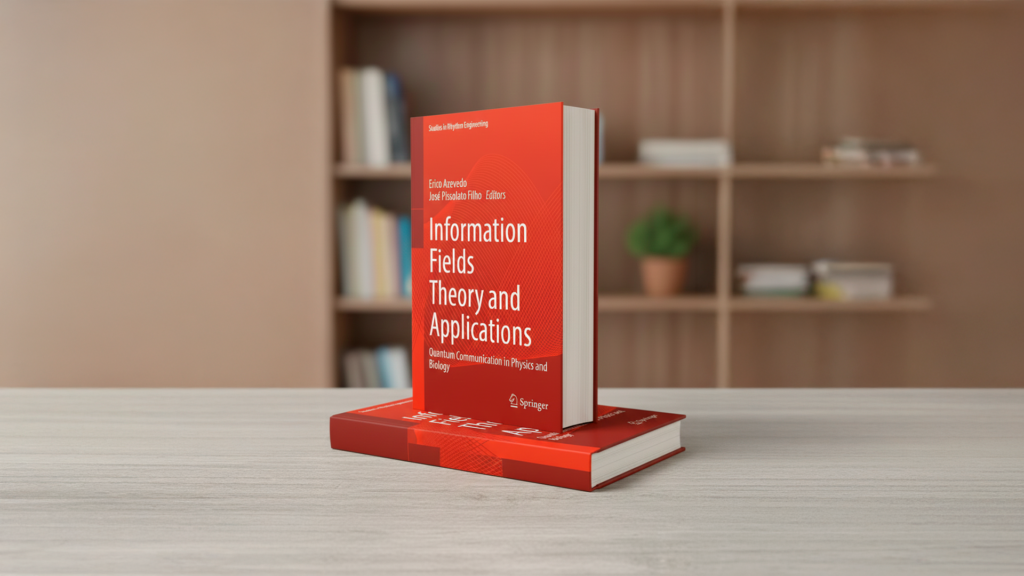
Quantum Communication in Physics and Biology
Springer Nature © 2026