
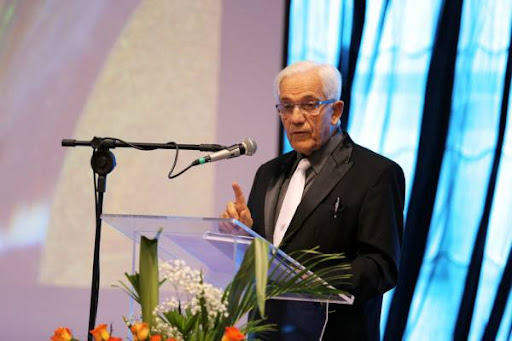
Alécio Vidor
How Alécio Vidor Grounds the Information Fields Revolution in the Philosophy of Being
About the Book
Information Fields: Theory and Applications (Springer Nature, 2026) is a landmark publication that establishes a new frontier in science. Edited by Erico Azevedo and José Pissolato Filho, this volume brings together 17 chapters from leading researchers around the world to explore how information—not just matter and energy—may be a fundamental building block of reality. The book bridges quantum physics, biology, and psychology, offering a unified framework for understanding how information organizes the universe, from entangled particles to human consciousness.
[Link to book: https://link.springer.com/book/9789819517411]
About the Author: The Philosopher Who Anchors the Vision
Alécio Vidor is a contemporary Brazilian philosopher and a former Professor at the Federal University of Santa Maria and Antonio Meneghetti Faculty (AMF) in Recanto Maestro, Brazil, whose intellectual trajectory is deeply connected to Ontopsychology, a science founded by Antonio Meneghetti. His work stands out both in theoretical production and in academic teaching, at the intersection of classical metaphysics, phenomenology, and the contemporary theory of knowledge.
As the author of the concluding chapter of this volume, Vidor performs an essential function: he grounds the entire project in the philosophical tradition, showing that the discoveries reported in the preceding chapters are not aberrations but fulfillments of insights that philosophy has long cultivated.
Vidor’s chapter is a fitting conclusion to a book that has traversed quantum physics, cellular biology, psychology, and medicine. It reminds us that science without philosophy is blind—and that the deepest questions about reality, consciousness, and knowledge cannot be answered by measurement alone. They require the kind of foundational reflection that only philosophy can provide.
Academic Career and Thought
Vidor graduated in Philosophy and Pedagogy. He consolidated his academic training in Italy, where he earned his Doctorate in Philosophy from the Pontifical University of Saint Thomas Aquinas (Angelicum) in Rome. As a thinker, his contribution focuses on the interdisciplinarity between classical philosophy (ontology) and humanistic psychology, working on the development of humanist culture and applied ontopsychological knowledge.
Recent Works
His literary production reflects the effort to translate complex philosophical concepts into the practice of human development and leadership. Among his notable works are:
- Phenomenology and Ontopsychology (2013): Explores the phenomenological bases that support the ontopsychological method.
- Ontopsychological Seminars (2025): A recent work that compiles lessons and reflections on the application of this science in daily life and in the formation of mindsets.
The Big Picture: Why This Chapter Concludes the Book
After sixteen chapters of empirical research, mathematical modeling, and clinical case studies, the reader might be tempted to think that information fields are just another scientific hypothesis—testable, measurable, useful. And they are. But they are also something more.
They are a window onto the deepest questions of existence: What is the nature of reality? How do we know what we know? What is the relationship between the One and the many, between Being and beings, between the transcendent and the immanent?
These are metaphysical questions. And for the past century, science has largely pretended they don’t exist. It has focused on the “how” and ignored the “why.” It has measured phenomena and bracketed their meaning. It has been spectacularly successful—and spectacularly incomplete. Vidor’s chapter brings metaphysics back into the conversation. It shows that the information fields investigated throughout this volume are not just physical primitives but also ontological principles—expressions of a deeper reality that philosophy has always known.
What This Chapter Does
Vidor’s chapter is brief but it is dense with meaning. It does three things that make it essential reading:
First, it articulates the ontological hierarchy that underlies the information fields framework. Drawing on the language of classical metaphysics, Vidor distinguishes between:
- BEING (with capitals): The Absolute, the Unmoved Mover, the source of all reality. It is transcendent, beyond space and time, the cause of causes.
- Being: The Spirit, the action of BEING in making itself the moving force of creation. It becomes unity from phenomenological multiplicity.
- being (lowercase): The ontic principle, the individual existent, the constituent of forms. It is the being when it grounds the constituent in connection with the unique original psyche.
Information fields, in this framework, are the “information of unitary continuity in diffuse multiplicity.” They are how the One expresses itself in the many, how the transcendent manifests in the immanent, how BEING communicates with beings.
Second, it establishes intuition as the foundation of all knowledge. Vidor returns to Husserl’s phenomenology and the concept of the Lifeworld—the pre-scientific, pre-logical world of direct experience. Before any theory, before any measurement, there is the raw givenness of reality. And our access to it is intuition.
Pure intelligence is the human mind when it sees and reads the innermost aspect of its own action, and intuition is the perception that grasps the vision of pure human intelligence.
Intuition is not a guess or a hunch. It is the primary perception of truth, the wellspring from which all genuine knowledge flows. Logic and reason are secondary—they analyze, synthesize, and formalize what intuition first grasps.
Third, it critiques the pretensions of artificial rationality. In a passage that speaks directly to our moment, Vidor writes:
The artificial entity is not intelligent because it lacks intuitive perception and creative ability; it merely reproduces what has been established and fixed in its program of action by human rational programming, whether conscious or unconscious.
Artificial intelligence, for all its power, cannot intuit. It cannot create. It cannot discern what is foreign to human identity. It is the servant of logic, not the master of truth. And when logic becomes disconnected from intuition—when it becomes an end in itself—it produces ideology, not science.
What You’ll Discover in This Chapter
Reading this brief but profound chapter, you will encounter:
The vision of a unified ontology. BEING, Being, being—three levels of reality that are distinct yet inseparable. Information fields are the medium through which they communicate, the “information of unitary continuity” that connects the transcendent to the immanent.
The defense of intuition as primary knowledge. In an age that worships data and algorithms, Vidor reminds us that data without intuition is blind. The greatest scientific discoveries have always come from those who could see what others could not—who trusted the leap of consciousness that Einstein described.
The critique of artificial rationality. Not Luddism, but a sober assessment of what machines can and cannot do. They can reproduce logic; they cannot create. They can follow programs; they cannot intuit truth. They are extensions of human reason, not replacements for human intelligence.
The call for a science grounded in ontic evidence. True science, Vidor argues, emerges when analytical methods remain tethered to the primary perception of intuition. When they become disconnected, they suffer from “opinion-based ideological contamination and fixations lacking the evidence necessary to Science.
The role of psychotherapy as corrective. When intuition is obscured—by cultural conditioning, by semantic networks, by fixed stereotypes—errors arise. Then psychotherapy becomes indispensable, not as a luxury but as a means of restoring access to the ontic core.
Connections to Other Chapters
Vidor’s philosophical conclusion resonates with and grounds the contributions of other authors:
- Chapter 1 (Azevedo & Pissolato): The field as fundamental primitive finds its metaphysical ground in the distinction between BEING, Being, and being.
- Chapter 2 (Sabbadini): The persistence of information in quantum reality reflects the “unitary continuity” that Vidor describes.
- Chapter 3 (Azevedo & Pissolato): Entanglement as topological connectivity is a physical expression of the Spirit’s action in making itself the moving force of creation.
- Chapter 9 (Sheldrake): Morphic resonance as collective memory aligns with Vidor’s “information of unitary continuity in diffuse multiplicity.”
- Chapter 10 (Meneghetti): Semantic fields as unconscious information transmission are the psychological manifestation of the ontological principles Vidor articulates.
- Chapter 11 (Radin et al.): Nonlocal experiences in quantum reality find their philosophical justification in the unity of BEING and Knowing.
- Chapter 13 (Goto): Phenomenology of consciousness, rooted in Husserl, is the methodological cousin of Vidor’s metaphysical vision.
- Chapter 14 (Azevedo & Perin): Information fields in psychology ground the ontic core in the individual being.
- Chapter 16 (Azevedo): Intuition in decision-making is the practical application of the pure intelligence Vidor describes.
Key Takeaways
- Reality is structured by an ontological hierarchy. BEING (Absolute), Being (Spirit), and being (individual) are distinct yet inseparable. Information fields are the medium of their communication.
- Intuition is the foundation of all knowledge. It is the primary perception of truth, the direct access to reality that precedes and informs all rational analysis.
- Logic and reason are secondary. They are tools for analyzing and formalizing what intuition first grasps. Disconnected from intuition, they produce ideology, not science.
- Artificial intelligence is not intelligent. It lacks intuition, creativity, and the capacity to discern what is foreign to human identity. It is an extension of human reason, not a replacement.
- Psychotherapy is indispensable. When intuition is obscured by cultural conditioning or psychological distortion, therapy restores access to the ontic core.
- Science must remain grounded in ontic evidence. True science emerges when analytical methods are tethered to the primary perception of intuition.
- Information fields are metaphysical realities. They are not just physical primitives but expressions of the “unitary continuity” that connects BEING to beings.
- The book finds its unity in this vision. Sixteen chapters of empirical research converge on the philosophical truth that Vidor articulates: reality is information, and we have access to it through intuition.
About the Author’s Contribution
Alécio Vidor has performed an essential service. In a volume dense with experimental data, mathematical models, and clinical observations, he has reminded us of what it all means. He has grounded the information fields revolution in the philosophical tradition, showing that the discoveries of contemporary science are not novelties but fulfillments of insights that philosophy has long cultivated.
His chapter is a fitting conclusion to a landmark book—a reminder that science without philosophy is blind, and that the deepest questions about reality require both.
For Further Exploration
- Antonio Meneghetti Faculty (AMF): Recanto Maestro, Brazil
- Key philosophers: Edmund Husserl (phenomenology), Antonio Meneghetti (Ontopsychology), Aristotle (metaphysics)
- Key concepts: BEING, Being, being, Unmoved Mover, pure intelligence, intuition, Lifeworld, ontic evidence
Explore other Information Fields book chapters
Part I: The Physical Realm
Chapter 1: Information Fields as a Fundamental Physical Primitive
Erico Azevedo & José Pissolato Filho
Chapter 2: The Persistence of Information in a Quantum Reality
Shantena Sabbadini
Chapter 3: Unveiling Quantum Entanglement
Erico Azevedo & José Pissolato Filho
Chapter 4: Fractal Hyperspace Engineering
Anirban Bandyopadhyay, Sudeshna Pramanik & Pushpendra Singh
Part II: The Biophysical Realm
Chapter 5: Long-Distance Cellular Communication: A Review
Mariana Cabral Schveitzer & Maria Luiza Bazzo
Chapter 6: Biofields and Bioenergy
Konstantin Korotkov
Chapter 7: Developmental Biology and Morphogenetic Fields
Ricardo Ghelman
Chapter 8: Imperfection as the Foundation of Life
Ivan V. Savelev, Michael M. Rempel, Oksana Polesskaya, Richard Alan Miller & Max Myakishev-Rempel
Part III: The Biopsychical Realm
Chapter 9: Morphic Resonance and Beyond
Rupert Sheldrake
Chapter 10: Semantic Fields,
Antonio Meneghetti
Chapter 11: Nonlocal Experiences in a Quantum Reality
Dean Radin, Helané Wahbeh, Garret Yount, Thomas Brophy, Sitara Taddeo & Arnaud Delorme
Chapter 12: Nonlocal Human Communication: A Unified Framework via the Field
Erico Azevedo
Chapter 13: Exploring the Dimensions of Consciousness
Tommy Akira Goto
Part IV: Applications
Chapter 14: Information Fields in Psychology
Erico Azevedo & Nathália Perin
Chapter 15: Medical Systems and Integrative Health
Ricardo Ghelman, Caio S. Portella & José Ruguê Ribeiro Junior
Chapter 16: Intuition and Noise in Decision Making
Erico Azevedo
Chapter 17: From Metaphysics to Science
Alécio Vidor
Conclusion
About ORIONT
ORIONT is an institute dedicated to research, training, and practical applications of Ontopsychology and human potential development. Co-founded by Erico Azevedo and Nathália Perin, it serves as a bridge between rigorous scientific investigation and the lived experience of human development. Through research, publications, and training programs, ORIONT carries forward the vision of a science that includes the full depth of human experience. [Website: https://oriont.org]
Stay tuned for our ongoing series exploring each chapter of Information Fields in depth. Follow us for deep dives into the frontiers of consciousness research!
#AlécioVidor #Metaphysics #Phenomenology #Intuition #PureIntelligence #InformationFields #SpringerNature #ORIONT #Husserl #Lifeworld #OnticPrinciple #PhilosophyOfScience #BookConclusion

Quantum Communication in Physics and Biology
Springer Nature © 2026