
Information Fields

Information Fields  — The Book

Information Fields Theory and Applications

How Scientists Are Rewriting the Architecture of Reality

About the Book

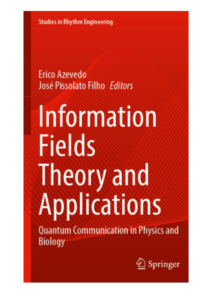
Information Fields: Theory and Applications (Springer Nature, 2026) is a landmark publication that establishes a new frontier in science. Edited by Erico Azevedo and José Pissolato Filho, this volume brings together 17 chapters from leading researchers around the world to explore how information—not just matter and energy—may be a fundamental building block of reality. The book bridges quantum physics, biology, and psychology, offering a unified framework for understanding how information organizes the universe, from entangled particles to human consciousness.

[Link to book: https://link.springer.com/book/9789819517411]

The Vision: A Unified Framework for Reality

For centuries, science has operated in silos. Physicists study particles. Biologists study cells. Psychologists study minds. These domains speak different languages, use different methods, and rarely meet.

But what if they are all studying the same thing?

What if information—not matter, not energy—is the fundamental building block of reality? What if the same principles that govern quantum entanglement also guide cellular development and shape conscious experience?

This is the revolutionary hypothesis at the heart of Information Fields: Theory and Applications. Across 17 chapters, the book’s contributors weave together evidence from quantum physics, biology, psychology, and consciousness studies into a coherent model of reality as an interconnected informational matrix. The result is not merely a collection of papers but a unified framework—one that resolves long-standing puzzles, opens new frontiers for technology and medicine, and repositions humanity within a cosmos that is far more connected than we ever imagined.

Download book intro

The Structure: Three Realms, One Theory

The book is organized into three parts, each exploring a different realm of reality through the lens of information fields, which is mathematically represented by ΨIΨ_I.

Part I: The Physical Realm — From Quantum Mysteries to Informational Unity

The journey begins with the foundations of physics, where information fields reveal themselves as the hidden architecture of quantum reality.

Chapter 1: Information Fields as a Fundamental Physical Primitive
Erico Azevedo & José Pissolato Filho

The opening chapter establishes ΨIΨ_I as a fundamental physical field—as real as electromagnetism, as real as gravity. Unlike traditional fields that carry energy, ΨIΨ_I carries pure organization: phase, topology, symmetry. It mediates nonlocal correlations without signal propagation, offering a mechanistic explanation for phenomena that have puzzled physicists for a century.

Read more

Chapter 2: The Persistence of Information in a Quantum Reality
Shantena Sabbadini

A theoretical physicist who later became a scholar of Taoism, Sabbadini bridges East and West. His chapter demonstrates that quantum superpositions and classical mixtures become empirically equivalent whenever any information about a measurement persists. The wavefunction never collapses—it only appears to, because information is preserved. This elegant resolution to the measurement problem resonates with ancient wisdom while remaining mathematically rigorous.

Read more

Chapter 3: Unveiling Quantum Entanglement
Erico Azevedo & José Pissolato Filho

From the EPR paradox to the 2022 Nobel Prize, this chapter traces the century-long quest to understand entanglement. Aspect’s 40σ violation of Bell’s inequalities and Zeilinger’s entanglement of buckyballs proved that nonlocality is fundamental. But what mediates it? The authors propose ΨIΨ_I as the answer: entanglement is not “spooky action” but topological connectivity within the information field.

Read more

Chapter 4: Fractal Hyperspace Engineering
Anirban Bandyopadhyay, Sudeshna Pramanik & Pushpendra Singh

This chapter dramatically expands and grounds ΨIΨ_I theory by providing a geometric and dynamical foundation. Bandyopadhyay and his team demonstrate that quantum mechanics emerges from a fractal Hilbert space whose effective dimension dF1.47d_F \approx 1.47 lies between classical and fully quantum regimes. Their Polyatomic-Time-Crystal (PTC⁶) manifold acts as a universal quantum transducer, converting geometric perturbations into measurable signals—a blueprint for room-temperature quantum sensors.

As the Introduction notes:

The Fractal Hilbert Hyperspace framework is to ΨIΨ_I what curved spacetime is to gravity—a dynamical geometry that is the field.

Read more

Part II: The Biophysical Realm — Life as an Informational Phenomenon

The second part reveals how information fields orchestrate life’s complexity, from cellular communication to morphogenesis.

Chapter 5: Long-Distance Cellular Communication: A Review
Mariana Cabral Schveitzer & Maria Luiza Bazzo

This systematic review identifies five mechanisms through which cells communicate via electromagnetic fields: ultra-weak photon emission (biophotons), intrinsic EMFs, bioelectric signaling, electromagnetic homeostasis, and photon tunneling. The evidence challenges reductionist assumptions and suggests that life is not merely biochemical but bioelectromagnetic—a symphony of frequencies and fields.

Read more

Chapter 6: Biofields and Bioenergy
Konstantin Korotkov

Korotkov, pioneer of Gas Discharge Visualization (GDV) electrophotography, presents evidence for the human biofield—an electromagnetic envelope surrounding the body that reflects physiological and psychological states. His work provides a window into the informational dynamics of living systems, bridging Eastern energy concepts with Western measurement.

Read more

Chapter 7: Developmental Biology and Morphogenetic Fields
Ricardo Ghelman

How does a single cell know to become a complex organism? Ghelman explores the role of morphogenetic fields in guiding development, regeneration, and healing. These fields—long hypothesized by biologists—find new grounding in ΨIΨ_I theory, suggesting that form is not merely genetically programmed but informationally guided.

Read more

Chapter 8: Imperfection as the Foundation of Life
Ivan V. Savelev, Michael M. Rempel, Oksana Polesskaya, Richard Alan Miller & Max Myakishev-Rempel

This chapter explores one of the most controversial frontiers in biology: the imprinting of DNA information on water. Building on Montagnier’s experiments, the authors investigate how genetic information can be transferred through aqueous nanostructures—a phenomenon that, if confirmed, would revolutionize our understanding of biological memory and communication.

Read more

Part III: The Biopsychical Realm — Consciousness and the Cosmic Web

The third part bridges matter and mind, revealing consciousness as an active participant in the informational cosmos.

Chapter 9: Morphic Resonance and Beyond
Rupert Sheldrake

Sheldrake’s famous theory of morphic resonance proposes that memory and habit are field phenomena. From protein folding to bird migration, natural systems are shaped by collective memory transmitted through morphic fields. His chapter reviews evidence from multiple domains. Morphic resonance can be connected to the broader ΨIΨ_I framework, suggesting that vibrational frequencies provide a physical substrate for his controversial but empirically supported theory.

Read more

Chapter 10: Semantic Fields
Antonio Meneghetti

Meneghetti’s first discovery in Ontopsychology, the semantic field describes unconscious information exchange between every living being. Every person constantly emits and receives information—intentions, states, needs—that shapes emotions, behaviors, and even health. This chapter, editorially reworked for accessibility, reveals how much of what we feel as “our own” may originate elsewhere—and how we can reclaim authentic perception.

Read more

Chapter 11: Nonlocal Experiences in a Quantum Reality
Dean Radin, Helané Wahbeh, Garret Yount, Thomas Brophy, Sitara Taddeo & Arnaud Delorme

The IONS team presents the best evidence for psi phenomena: telepathy (8.1σ in ganzfeld studies), precognition (11σ across 309 studies), and mind-matter interaction (6.8σ in RNG experiments). Their rigorous meta-analyses demonstrate that nonlocal consciousness is not mysticism but empirically validated reality—one that finds natural explanation within ΨIΨ_I theory.

Read more

Chapter 12: Nonlocal Human Communication: A Unified Framework via the ΨIΨ_I Field
Erico Azevedo

Azevedo’s own Faraday-caged experiments demonstrate autonomic nervous system synchronization between isolated subjects (p<0.001p<0.001). This chapter presents these results as evidence for ΨIΨ_I-mediated human communication, connecting the physical framework of earlier chapters to the lived experience of connection.

Read more

Chapter 13: Exploring the Dimensions of Consciousness
Tommy Akira Goto

Grounding the biopsychical realm in philosophical rigor, Goto applies Husserlian phenomenology to the study of psychic, parapsychological, and anomalistic experiences. He argues that ΨIΨ_I provides the missing link between subjective experience and objective physics—making the Lebenswelt concept concrete.

Read more

Part IV: Applications — From Theory to Transformation

The final part translates the theoretical framework into practical applications across medicine, psychology, decision-making, and ethics.

Chapter 14: Information Fields in Psychology
Erico Azevedo & Nathália Perin

By attuning to clients’ dominant information fields—through dream analysis, ANS monitoring, or semantic field perception—therapists can identify subconscious blockages with unprecedented precision. This chapter outlines a new approach to psychotherapy grounded in informational dynamics.

Read more

Chapter 15: Medical Systems and Integrative Health
Ricardo Ghelman, Caio S. Portella & José Ruguê Ribeiro Junior

If health is a dynamic equilibrium of information flow, then disease represents informational disruption. This chapter explores ancient medical rationalities revealing how they restore coherence without invasive interventions, exploring topics such as placebo effects understood as field resonance to bioresonance therapies grounded in new physics.

Read more

Chapter 16: Intuition and Noise in Decision Making
Erico Azevedo

Intuition—often dismissed as heuristic bias—becomes in this framework a tangible interaction with informational reality. Azevedo reinterprets Kahneman’s prospect theory through ΨIΨ_I‘s lens, offering tools for distinguishing authentic intuition from informational noise.

Read more

Chapter 17: From Metaphysics to Science
Alécio Vidor

The volume concludes with philosophical reflection. If information fields underpin reality, then ethics must expand to include informational integrity. Harm—whether emotional or environmental—disrupts ΨIΨ_I coherence. Vidor argues for a new ethical framework grounded in the interconnected nature of reality.

Read more

The Unifying Vision

As the Introduction states:

The 20th century unveiled the quantum world; the 21st will decode its language. ΨIΨ_I is that grammar—written in the alphabet of entanglement, coherence, and meaning.

What emerges from this volume is a grand unification of science:

RealmCore DiscoveryKey EvidenceChapters
PhysicalΨIΨ_I mediates quantum nonlocality via topological phase-lockingAspect’s entanglement experiments; Sabbadini’s informational persistence1–4
BiophysicalCells and organisms communicate via ΨIΨ_I-driven solitons and biophotonsMontagnier’s DNA waves; Korotkov’s GDV imaging; Bazzo & Schveitzer’s review5–8
BiopsychicalConsciousness operates within a nonlocal informational fieldSheldrake’s morphic resonance; Radin’s psi meta-analyses; Azevedo’s ANS sync9–13

The Contributors: A Gathering of Visionaries

Anirban Bandyopadhyay — Senior Scientist at NIMS Japan, whose experimental demonstration of quantum coherence in microtubules at room temperature challenges conventional assumptions about the limits of quantum biology.

Dean Radin — Chief Scientist at IONS, author of Entangled Minds, whose meta-analyses have established psi phenomena on firm statistical ground.

Rupert Sheldrake — Former Cambridge biochemist, author of A New Science of Life, whose theory of morphic resonance has influenced generations of researchers.

Antonio Meneghetti — Founder of Ontopsychology, whose three discoveries—the ontic In Sè, the monitor of deflection, and the semantic field—provide psychological depth to the information fields framework.

Konstantin Korotkov — Pioneer of Gas Discharge Visualization, whose bioelectrography techniques capture the body’s electromagnetic emissions.

Shantena Sabbadini — Former particle physicist at UC Santa Barbara, translator of the Tao Te Ching and I Ching, guide at the Eranos Foundation—a unique bridge between quantum mechanics and Eastern wisdom.

Erico Azevedo & José Pissolato Filho — The editors and architects of the ΨIΨ_Iframework, whose collaboration spans engineering, psychology, and philosophy.

Mariana Cabral Schveitzer & Maria Luiza Bazzo — Brazilian researchers whose systematic review establishes the empirical foundations for electromagnetic cellular communication.

Rciardo Ghelman, Caio S. Portella & José Ruguê Ribeiro Junior — Pioneers in integrative medicine, applying field theory to health and healing.,

Tommy Akira Goto — Phenomenologist who grounds the study of anomalous experiences in philosophical rigor.

Nathália Perin — Psychotherapist and researcher, co-founder and Director of ORIONT institute.

Max Myakishev Rempel — founder of the DNA Resonance Research Foundation, is a molecular biologist researching evidence of non-human genetic manipulation in human DNA.

Alécio Vidor — Philosopher who draws out the ethical implications of an interconnected universe.

And the many co-authors whose contributions enrich every chapter: Helané Wahbeh, Garret Yount, Thomas Brophy, Sitara Taddeo, Arnaud Delorme, Sudeshna Pramanik, Pushpendra Singh, Ivan V. Savelev, Michael M. Rempel, Oksana Polesskaya and Richard Alan Miller.

Why This Book Matters

Information Fields: Theory and Applications is not merely a collection of papers. It is a paradigm shift—a re-founding of science on deeper principles.

For Physics: It resolves the quantum measurement problem, explains nonlocality without “spooky action,” and offers a pathway to unify quantum mechanics and gravity.

For Biology: It explains how cells communicate without chemical signals, how morphogenesis is guided, and how life exploits quantum coherence.

For Psychology: It transforms consciousness from an epiphenomenon into an active participant in reality, validates psi phenomena with rigorous meta-analyses, and offers new tools for therapy.

For Medicine: It grounds integrative and energy medicine in testable physics, explains placebo and distant healing effects, and opens new therapeutic avenues.

For Technology: It provides blueprints for room-temperature quantum sensors, decoherence-immune computing, and entirely new modes of communication.

For Philosophy: It resolves the ancient tension between materialism and idealism, offers a framework for understanding consciousness, and demands a new ethics of informational integrity.

For Humanity: It reveals a universe far more connected, far more alive, far more meaningful than the mechanical cosmos of classical science. We are not isolated individuals in a dead universe. We are participants in a living, informational reality.

Key Takeaways

  1. Information is physical. ΨIΨ_I is a fundamental field, as real as electromagnetism—not an abstraction.
  2. Nonlocality is topology. Entanglement is not “spooky action” but topological connectivity in ΨIΨ_I.
  3. Life is informational. Cells communicate through biophotons, EMFs, and quantum coherence—not just chemicals.
  4. Consciousness is nonlocal. Rigorous meta-analyses demonstrate telepathy, precognition, and mind-matter interaction.
  5. The evidence is robust. From Aspect’s 40σ Bell violations to Radin’s 8.1σ ganzfeld results, the data is clear.
  6. The framework is unified. The same ΨIΨ_I principles operate across quantum, biological, and psychological realms.
  7. Applications are transformative. Medicine, Economics, Psychology, Technology, and Ethics all stand to be revolutionized.

The time is now. As the editors write: 

The age of information fields is not coming—it has arrived. Will you witness it or help to shape it?

Final Thoughts

Information Fields: Theory and Applications is a landmark publication—one that will be looked back on as a turning point in scientific history. It brings together the evidence, the theory, and the vision for a new paradigm. It gathers the researchers who have done the work and invites us to see what they have seen.

The universe is not a machine. It is an information field—self-organizing, interconnected, alive. And we are not separate from it. We are nodes in the network, receivers and transmitters, participants in a cosmic conversation. The book is an invitation to join that conversation.

For Further Exploration

Stay tuned for our ongoing series exploring each chapter of Information Fields in depth. Follow us for deep dives into the frontiers of consciousness research!

#InformationFields #SpringerNature #DeanRadin #RupertSheldrake #AntonioMeneghetti #AnirbanBandyopadhyay #KonstantinKorotkov #ShantenaSabbadini #EricoAzevedo #JosePissolatoFilho #QuantumRevolution #NewParadigm #ORIONT #Consciousness #QuantumBiology #Nonlocality #Entanglement #MorphicResonance #SemanticField #PsiResearch #IntegrativeMedicine

Information Fields Theory and Applications
Quantum Communication in Physics and Biology
Springer Nature © 2026

Previous — Index — Next