
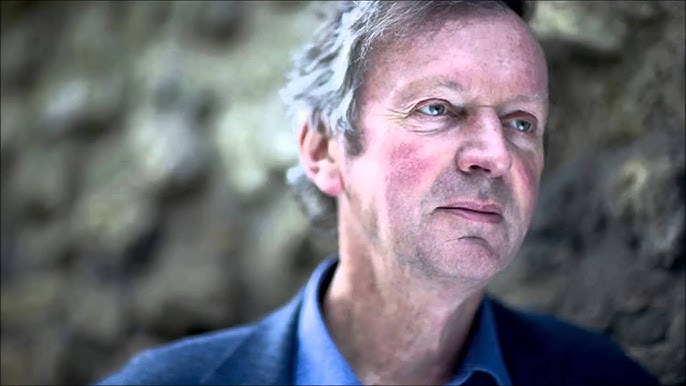
Rupert Sheldrake
How Rupert Sheldrake Reveals the Collective Memory of Nature
About the Book
Information Fields: Theory and Applications (Springer Nature, 2026) is a landmark publication that establishes a new frontier in science. Edited by Erico Azevedo and José Pissolato Filho, this volume brings together 17 chapters from leading researchers around the world to explore how information—not just matter and energy—may be a fundamental building block of reality. The book bridges quantum physics, biology, and psychology, offering a unified framework for understanding how information organizes the universe, from entangled particles to human consciousness.
[Link to book: https://link.springer.com/book/9789819517411]
About the Author: : A Biologist Who Dared to Question Everything
Rupert Sheldrake, PhD, is one of the most provocative and influential biologists of our time—a scientist who has spent decades challenging the fundamental assumptions of modern biology with courage, rigor, and an open mind.
A former Research Fellow of the Royal Society and Director of Studies in biochemistry and cell biology at Cambridge University, Sheldrake has impeccable scientific credentials. But unlike many of his peers, he refused to accept that the mechanistic worldview—the idea that life can be fully explained by genes and chemistry alone—tells the whole story.
His journey has been anything but conventional. When his first book, A New Science of Life, was published in 1981, the prestigious journal Nature called it “a candidate for burning.” Such was the resistance to ideas that challenged the orthodoxy. Yet Sheldrake persisted, refining his hypotheses, conducting experiments, and gathering evidence. Decades later, his work on morphic resonance has influenced fields from biology to psychology to consciousness studies, and his books have sold millions worldwide.
Key Books by Rupert Sheldrake:
- A New Science of Life: The Hypothesis of Formative Causation (1981): His groundbreaking work proposing that biological form and behavior are shaped by morphic fields, influenced by the collective memory of the species.
- The Presence of the Past: Morphic Resonance and the Habits of Nature (1988): Expands the theory to include memory, instinct, and the evolution of form, arguing that nature’s habits are reinforced through resonance with past similar systems.
- Seven Experiments That Could Change the World (1994): Proposes accessible experiments anyone can conduct to test the boundaries of conventional science.
- The Sense of Being Stared At, and Other Aspects of the Extended Mind (2003): Explores evidence that minds extend beyond brains.
- Ways to Go Beyond and Why They Work (2019): Investigates spiritual practices through a scientific lens.
The Central Idea: Nature Has Habits, Not Just Laws
What if the “laws of nature” are not eternal, fixed rules written at the beginning of time? What if they are more like habits—patterns that have become stable through repetition?
This is the radical proposal at the heart of Sheldrake’s work. He suggests that natural systems—from crystals to proteins to organisms to societies—are shaped by morphic fields that contain a kind of collective memory. When a pattern repeats often enough, it becomes easier for similar systems to replicate it, through a process he calls morphic resonance.
Think of it this way: when the first snowflake formed, it was difficult. The water molecules had to “figure out” how to arrange themselves into that exquisite hexagonal pattern. But once that pattern existed, it became easier for subsequent snowflakes to form the same way. Each snowflake resonates with all the snowflakes that came before, tapping into a kind of collective memory of snowflakeness.
This is not a metaphor for Sheldrake. It is a physical hypothesis, generating testable predictions across multiple domains.
The Lineage: Fields Upon Fields
Sheldrake begins his chapter by tracing the evolution of the field concept in physics—a beautiful intellectual history that sets the stage for his own contribution.
- Michael Faraday introduced the idea of “lines of force” around magnets—invisible structures that were not made of ordinary matter but were nonetheless real.
- James Clerk Maxwell mathematicalized Faraday’s intuition, showing that electromagnetic fields could propagate as waves.
- Quantum field theory went further, revealing that particles themselves are excitations of underlying fields. An electron is not a tiny billiard ball; it’s a quantum of the electron field.
- David Bohm proposed that even the quantum potential—the “information” guiding particles—could be understood as a field.
Sheldrake builds on this lineage, asking a simple question: if atoms and particles have fields, why not molecules? Why not cells? Why not organisms? Why not societies?
He proposes that at every level of organization, there exists a corresponding morphic field—a field that organizes the form and behavior of that system. The insulin molecule is a manifestation of the insulin morphic field; a swan is a manifestation of the swan morphic field; a beehive is a manifestation of the beehive morphic field. These fields are not static. They evolve as the systems they organize evolve. And they are connected across time through morphic resonance—the influence of similar past patterns on present ones.
The Evidence: Anomalies That Demand Explanation
What makes Sheldrake’s work compelling is that he doesn’t just propose a theory—he points to phenomena that mainstream science struggles to explain, and shows how morphic resonance offers a coherent account.
Protein Folding
Proteins are long chains of amino acids that must fold into specific three-dimensional shapes to function. The number of possible conformations is astronomically large—yet proteins fold into their correct shapes in milliseconds. How do they “know” which shape to take? Mainstream science admits this is an unsolved problem. Sheldrake suggests that proteins are guided by morphic fields shaped by countless previous foldings of the same protein.
Crystallization
Chemists have long observed that newly synthesized compounds are often difficult to crystallize at first. But over time—sometimes weeks or months—they become easier to crystallize. The conventional explanation is that tiny “seeds” of crystals spread through dust or travel. But Sheldrake points out that this doesn’t fully explain the pattern. Morphic resonance offers an alternative: each time a crystal forms, it strengthens the morphic field for that compound, making subsequent crystallization easier.
Inheritance of Acquired Characteristics
In the 1920s, William McDougall conducted experiments with rats learning to escape from a water maze. He found that successive generations learned faster—even when he bred from the slowest learners. Similar results were found by other researchers. Mainstream genetics dismissed these findings, but they have never been adequately explained. Sheldrake suggests that morphic resonance could account for them: each generation of rats resonates with the learning of previous generations.
Milk Bottle Opening by Birds
In 1921, blue tits in Britain discovered how to peck through the foil caps of milk bottles to drink the cream. Within decades, this behavior had spread across the country—and to Sweden, Denmark, and Holland. The conventional explanation is imitation and cultural transmission. But the speed and pattern of spread, and the fact that it appeared independently in multiple locations, suggests something more. Sheldrake proposes that morphic resonance made it easier for birds everywhere to “tune into” the new behavior.
Cattle Grid Avoidance
Cattle grids—bars set into the road that cattle won’t cross—have been used for centuries. But in recent decades, farmers have reported that cattle learn to cross them, and that this learning spreads rapidly. Remarkably, even painted cattle grids—with no physical bars at all—can be effective, suggesting that the animals are responding to the idea of the grid, transmitted through morphic resonance. These are not isolated anecdotes. They are patterns that recur across domains, pointing to something that conventional biology cannot explain.
Morphic Resonance and Human Learning
Perhaps the most accessible evidence for morphic resonance comes from human experience.
Language Learning
Children learn to speak with astonishing speed, mastering complex grammatical structures without explicit instruction. Noam Chomsky proposed that this is possible because of an innate “universal grammar” encoded in our genes. But Sheldrake offers a simpler explanation: children resonate with the linguistic fields of all those who have spoken before them. Learning English is easier than learning a rare tribal language not because of genetic differences, but because millions have spoken English before.
The Flynn Effect
IQ scores have been rising steadily for decades—about 3 points per decade in many countries. This is too fast to be explained by genetic change. Psychologists have proposed various explanations (better nutrition, more schooling, increased test familiarity), but none fully account for the pattern. Sheldrake suggests that morphic resonance may be at work: as millions of people take IQ tests, it becomes easier for subsequent generations to do well on them. We’re not getting smarter; we’re tapping into a collective memory of test-taking.
Physical Skills
When Roger Bannister broke the four-minute mile in 1954, it was considered a nearly impossible feat. Within years, dozens of runners had done the same. Today, it’s routine for elite athletes. While training and nutrition have improved, Sheldrake suggests that morphic resonance also plays a role: once a pattern exists, it becomes easier for others to replicate.
The Deepest Implications: Memory Without Storage
A radical implication of Sheldrake’s theory concerns the nature of memory itself.
Mainstream neuroscience assumes that memories are stored in the brain as physical traces—engrams—that can be located, damaged, or stimulated. Yet after decades of research, no one has found a memory trace. Karl Lashley spent decades trying to locate engrams in rats, training them to run mazes and then lesioning parts of their brains. He never found a spot where memory was exclusively stored. Memories seemed to be everywhere and nowhere.
Moreover, the brain is in constant flux. Proteins are replaced, synapses remodeled, neurons die and are (in some regions) regenerated. How could stable memories persist in such a dynamic system?
Sheldrake proposes a radical alternative: memories are not stored in the brain at all. They are accessed through morphic resonance with our own past states. The brain is more like a TV receiver than a hard drive. Damage to the brain doesn’t destroy memories; it impairs the ability to tune into them.
This explains phenomena that are puzzling on the storage model:
- Retrograde amnesia: Patients may lose access to memories after trauma, but often recover them later—suggesting the memories weren’t destroyed, just inaccessible.
- Penfield’s electrical stimulation: When Penfield stimulated the brains of conscious patients, they sometimes reported vivid memory-like experiences. But he later concluded these were not stored memories being “played back,” but constructions stimulated by the electrode.
- Recognition without recall: We often recognize something we cannot consciously recall—as if the memory is there but we can’t quite tune in.
The morphic resonance model also explains why similar experiences tend to blur together. Each new experience resonates with similar past ones, creating a composite that preserves the pattern but loses individual details. This is not a failure of storage but the natural consequence of resonance.
Connections to Other Thinkers
Sheldrake’s work resonates deeply with other thinkiers:
- Carl Jung’s collective unconscious—the idea that we all share access to a common pool of archetypal patterns—finds a natural explanation in morphic resonance.
- Antonio Meneghetti’s semantic field—the transmission of unconscious information between people—describes how morphic resonance operates in human relationships.
- Dean Radin’s psi research—telepathy, precognition, mind-matter interaction—becomes theoretically plausible as resonance with distant or future patterns.
- Anirban Bandyopadhyay’s fractal hyperspace—the geometric architecture underlying quantum mechanics—could provide the mathematical foundation for how morphic fields are structured.
Sheldrake himself acknowledges a deep connection, particularly to Carl Jung collective unconscious and David Bohm’s implicate order—the idea that the manifest world (explicate order) unfolds from a deeper, enfolded reality. Morphic fields, in this view, belong to the implicate order, and morphic resonance is how past forms influence present ones across time.
Addressing the Skeptics
Sheldrake is no stranger to criticism. His ideas have been dismissed, mocked, and even censored. But he addresses the major objections with characteristic clarity:
“This sounds like dualism.”
Morphic fields are no more dualistic than gravitational fields. They are physical fields that interact with the systems they organize—just as the gravitational field interacts with masses. The fact that we don’t yet know how to measure them directly doesn’t make them spooky.
“Where’s the evidence?”
The evidence is everywhere—in the unsolved problems of protein folding, crystallization, inheritance, memory, and behavior. Mainstream science has no adequate explanations for these phenomena. Morphic resonance offers a unified account that generates testable predictions.
“This is just Lamarckism rebranded.”
Lamarckism proposed that acquired characteristics are inherited through genetic changes. Morphic resonance is different: it proposes that patterns are inherited through non-genetic resonance with past forms. The two are not the same, and morphic resonance is supported by evidence that Lamarckism is not.
“If morphic resonance is real, why can’t we detect it in controlled experiments?”
We can—and Sheldrake reviews dozens of experiments that support the hypothesis, from McDougall’s rat studies to modern tests with language learning and hidden images. The effects are small but statistically significant, and they appear exactly where the theory predicts.
Why This Chapter Matters
Sheldrake’s work is not just about biology. It’s about the nature of reality itself.
If morphic resonance is real, then:
- Nature is not mechanical but habitual. The laws of nature are not eternal decrees but evolving patterns.
- Memory is not stored in brains. We are not isolated individuals but participants in a vast, collective memory.
- Inheritance is not just genetic. We inherit habits, behaviors, and forms from all who came before.
- Mind extends beyond brain. Our thoughts, feelings, and perceptions are not locked inside our skulls but resonate with the world.
- Telepathy and precognition become plausible. If we can resonate with past patterns, why not with distant or future ones?
These are not merely academic propositions. They touch the deepest questions of who we are, where we come from, and what we are capable of becoming.
Final Thoughts
Reading Sheldrake’s chapter, one feels the presence of a mind that has spent decades thinking deeply about the biggest questions—and refusing to accept easy answers. His prose is clear, his arguments careful, his evidence meticulously gathered. He does not ask us to believe; he asks us to look, to question, to experiment.
The chapter is not a final statement but an opening—an invitation to explore a world that is far more interesting, far more connected, far more alive than the mechanical universe of conventional biology.
As Sheldrake writes in his opening epigraph, quoting his own book The Presence of the Past:
Morphic fields are shaped by the collective memory of a species. The more a pattern is repeated, the stronger its influence becomes through resonance.
We are not isolated individuals living in a dead universe. We are participants in an ongoing, evolving, resonating whole. And the patterns we create today will shape the world of tomorrow.
Key Takeaways
- Nature has habits, not just laws. What we call “laws of nature” may be stable patterns reinforced through repetition.
- Morphic fields organize form and behavior. From molecules to societies, systems are shaped by fields that contain collective memory.
- Morphic resonance connects past and present. Similar patterns influence each other across time, making repetition easier.
- Evidence spans multiple domains. Protein folding, crystallization, inheritance, animal behavior, and human learning all show patterns consistent with morphic resonance.
- Memory may not be stored in brains. The failure to find memory traces suggests an alternative: we access memories through resonance with our own past.
- Inheritance is more than genetic. We inherit habits, behaviors, and forms through resonance with all who came before.
- Mind extends beyond brain. Our thoughts and perceptions may resonate with the world, explaining phenomena like telepathy and the sense of being stared at.
- The theory is testable. Morphic resonance generates specific predictions that can be—and have been—tested experimentally..
About the Author’s Journey
Rupert Sheldrake‘s path—from Cambridge don to scientific maverick—is a testament to the courage required to question orthodoxy. He has faced dismissal, ridicule, and censorship, yet he has never stopped asking questions, gathering evidence, and refining his ideas. His presence in this volume is a reminder that science progresses not by consensus but by dissent—by those willing to follow the evidence wherever it leads, even when it challenges deeply held beliefs.
For Further Exploration
- Rupert Sheldrake’s Official Website: https://www.sheldrake.org
- Key Books: A New Science of Life, The Presence of the Past, The Sense of Being Stared At
- Morphic Resonance Experiments:https://www.sheldrake.org/research
Explore other Information Fields book chapters
Part I: The Physical Realm
Chapter 1: Information Fields as a Fundamental Physical Primitive
Erico Azevedo & José Pissolato Filho
Chapter 2: The Persistence of Information in a Quantum Reality
Shantena Sabbadini
Chapter 3: Unveiling Quantum Entanglement
Erico Azevedo & José Pissolato Filho
Chapter 4: Fractal Hyperspace Engineering
Anirban Bandyopadhyay, Sudeshna Pramanik & Pushpendra Singh
Part II: The Biophysical Realm
Chapter 5: Long-Distance Cellular Communication: A Review
Mariana Cabral Schveitzer & Maria Luiza Bazzo
Chapter 6: Biofields and Bioenergy
Konstantin Korotkov
Chapter 7: Developmental Biology and Morphogenetic Fields
Ricardo Ghelman
Chapter 8: Imperfection as the Foundation of Life
Ivan V. Savelev, Michael M. Rempel, Oksana Polesskaya, Richard Alan Miller & Max Myakishev-Rempel
Part III: The Biopsychical Realm
Chapter 9: Morphic Resonance and Beyond
Rupert Sheldrake
Chapter 10: Semantic Fields
Antonio Meneghetti
Chapter 11: Nonlocal Experiences in a Quantum Reality
Dean Radin, Helané Wahbeh, Garret Yount, Thomas Brophy, Sitara Taddeo & Arnaud Delorme
Chapter 12: Nonlocal Human Communication: A Unified Framework via the Field
Erico Azevedo
Chapter 13: Exploring the Dimensions of Consciousness
Tommy Akira Goto
Part IV: Applications
Chapter 14: Information Fields in Psychology
Erico Azevedo & Nathália Perin
Chapter 15: Medical Systems and Integrative Health
Ricardo Ghelman, Caio S. Portella & José Ruguê Ribeiro Junior
Chapter 16: Intuition and Noise in Decision Making
Erico Azevedo
Chapter 17: From Metaphysics to Science
Alécio Vidor
About ORIONT
ORIONT is an institute dedicated to research, training, and practical applications of Ontopsychology and human potential development. Co-founded by Erico Azevedo and Nathália Perin, it serves as a bridge between rigorous scientific investigation and the lived experience of human development. Through research, publications, and training programs, ORIONT carries forward the vision of a science that includes the full depth of human experience. [Website: https://oriont.org]
Stay tuned for our ongoing series exploring each chapter of Information Fields in depth. Follow us for deep dives into the frontiers of consciousness research!
#RupertSheldrake #MorphicResonance #InformationFields #CollectiveMemory #SpringerNature #ORIONT #Consciousness #Biology #Epigenetics #ScienceRevolution

Quantum Communication in Physics and Biology
Springer Nature © 2026