
The Information Fields Manifesto for a New Science
A Call to Remember What Our Equations Have Been Whispering All Along
About the Book
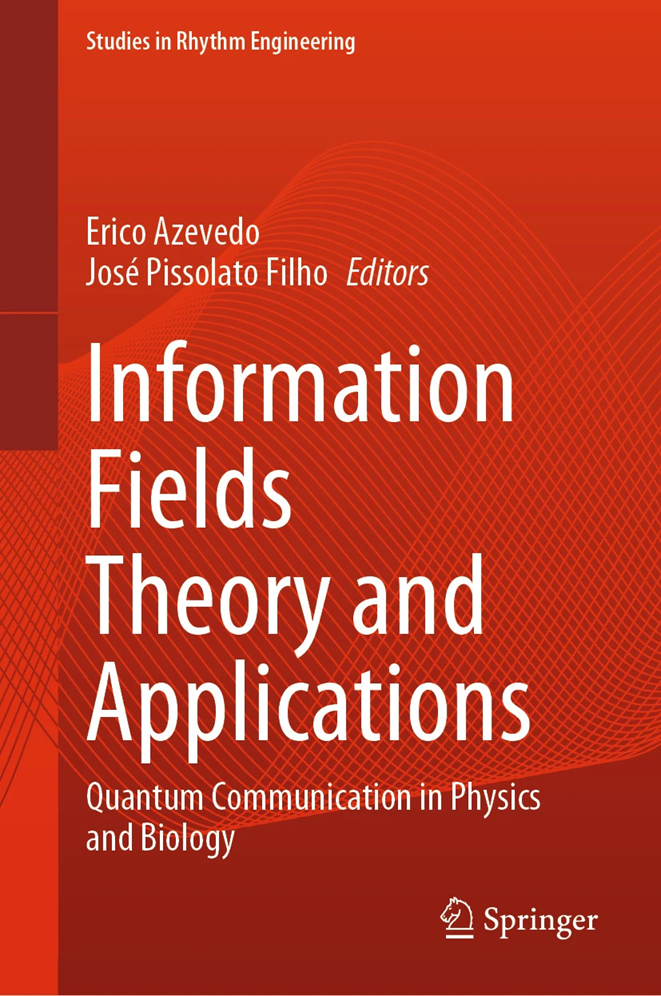
Information Fields: Theory and Applications (Springer Nature, 2026) is a landmark publication that establishes a new frontier in science. Edited by Erico Azevedo and José Pissolato Filho, this volume brings together 17 chapters from leading researchers around the world to explore how information—not just matter and energy—may be a fundamental building block of reality. The book bridges quantum physics, biology, and psychology, offering a unified framework for understanding how information organizes the universe, from entangled particles to human consciousness.
[Link to book: https://link.springer.com/book/9789819517411]
The Big Picture: A Crossroads for Science
We stand at a crossroads.
Not the kind that appears in textbooks—neat, theoretical, safely academic. A real crossroads. An existential one.
For a century, science has operated on a fragmented model. Physics studies particles. Biology studies cells. Psychology studies minds. Each discipline has its own language, its own methods, its own assumptions. And each has achieved remarkable successes.
But the fragmentation has also produced blindness.
Physics has discovered nonlocality—instantaneous connections across any distance—but struggles to integrate it into a coherent worldview. Biology has documented extraordinary coherence in living systems—from DNA solitons to microtubule vibrations—but lacks a framework to explain it. Psychology has accumulated a wealth of clinical wisdom—from Freud’s unconscious to Jung’s synchronicity—but cannot ground it in fundamental science.
Meanwhile, our headlong rush into artificial intelligence has created systems that mimic human reasoning while remaining utterly alien to the ontic core that gives meaning to human thought. We have built machines that can beat us at chess but cannot tell us why we play.
As Husserl warned in 1936, the “crisis of European sciences” was not a crisis of facts but a crisis of meaning. We had become so focused on measuring the world that we forgot to ask what it means. We had perfected our methods and lost our questions. That crisis has now come to full fruition.
Download conclusion | Buy the book
What This Book Has Shown
Across seventeen chapters, this volume has made a single, coherent argument: information is not merely a property of the universe—it is the very fabric from which reality is woven.
In physics, we have seen that quantum entanglement, nonlocality, and the measurement problem find elegant resolution when we recognize information fields () as a fundamental physical primitive. The same equations that describe entangled photons also describe the phase-locked dynamics of human dyads. Fractal hyperspace geometry—with its polyatomic-time-crystal manifold () and ordered-factor metric—reveals a universe where quantum coherence emerges from a single geometric primitive, orchestrated by phase-locked oscillations in a fractal Hilbert tower of dimension .
In biology, we have seen that cells communicate through biophotons and electromagnetic fields, that DNA functions as a vibrational hologram, that morphogenesis is guided by fields that transcend genetic programming. Gurwitsch’s mitogenetic radiation, Montagnier’s DNA solitons, Popp’s biophotons, Bandyopadhyay’s microtubule coherence—all point to the same conclusion: life is not merely biochemical but informational, organized by fields that carry form and meaning without energetic transfer.
In psychology, we have seen that dreams are geometric projections of the ontic core, that intuition is resonance with environmental information fields, that therapeutic transformation occurs when field coherence is restored. Meneghetti’s semantic fields, Jung’s synchronicity, Husserl’s phenomenology—all find their ground in the same dynamics that entangle particles and coordinate cells.
In medicine, we have seen that ancient traditions—Ayurveda, Traditional Chinese Medicine, Anthroposophic Medicine—have been describing information fields for millennia. Their concepts of Doshas, Qi, and morphogenetic fields are not primitive superstitions but sophisticated frameworks for understanding the informational organization of life, now being validated by contemporary science.
In decision-making, we have seen that intuition, properly accessed, provides insights that rational analysis alone cannot match. The biases that Kahneman documented are real—but they are noise in the field, not the whole story. When we learn to clear the noise, intuition sings clear.
Download conclusion | Buy the book
What the Equations Reveal
The mathematical formalism developed throughout this volume is not merely decorative. It reveals something profound:
The continuity equation for information flux——shows that information is conserved, that it flows, that it has sources. This is not metaphor. It is physics.
The Lagrangian——shows that information fields have dynamics, that they interact with matter, that they can be modeled with the same mathematical tools we use for any fundamental field.
The nonlocal kernel shows that correlations can be instantaneous without violating causality—because they are not signals but topological connections, encoded in the geometry of the field itself.
The fractal dimension shows that reality is neither purely classical () nor purely quantum () but something in between—a fractal landscape where coherence is partial but real, where order and chaos dance in dynamic balance.
The cortical-thalamic integration formula——shows that consciousness itself can be modeled as an interaction between the information field and neural dynamics.
This is not reductionism. It is integration.
Download conclusion | Buy the book
What the Experiments Confirm
The mathematics would be empty without empirical confirmation. But the confirmation is there:
- Aspect’s 40σ violation of Bell’s inequalities
- Zeilinger’s entanglement of buckyballs and GHZ states
- Radin’s 8.1σ ganzfeld meta-analyses
- Azevedo’s 96% physiological synchrony in Faraday-caged dyads ()
- Bandyopadhyay’s terahertz microtubule vibrations
- Montagnier’s DNA solitons in shielded environments
- Korotkov’s GDV correlations with HRV and cortisol
- Ghelman’s morphogenetic field observations in embryology
- Perin and Azevedo’s clinical validation of dream-based therapy
- The Global Consciousness Project’s 7.3σ deviations during world events
The evidence is not anecdotal. It is not marginal. It is accumulated across decades, across laboratories, across disciplines. It meets the highest standards of statistical rigor. And it all points in the same direction: information fields are real.
Download conclusion | Buy the book
The False Dichotomy
For too long, we have been trapped in a false dichotomy:
Either reduce reality to sterile materialism—particles in motion, genes in cells, neurons in brains—or abandon empiricism for mystical abstraction. Either measure without meaning, or mean without measure.
This dichotomy has crippled science. It has forced us to choose between rigor and depth, between precision and significance, between the quantifiable and the real.
The information field paradigm reveals the third way.
theory demands neither the renunciation of rigor nor the denial of lived experience. It shows that Schrödinger’s equations and semantic fields are complementary perspectives on a unified informational reality. It shows that the boundaries between physics and psychology, between matter and mind, were always illusions born of incomplete understanding. It does not unite these domains—it reveals that they were never truly separate.
Download conclusion | Buy the book
The Path Forward
If this vision is correct—and the evidence suggests it is—then the path forward demands nothing less than a radical reorientation of scientific practice.
Train researchers to perceive directly. This means cultivating what Husserl called Wesensschau—the intuition of essences—through disciplined phenomenological observation. It means learning to read dreams as geometric projections, to feel semantic fields as directly as we feel temperature, to recognize the difference between authentic intuition and cultural noise. This is a simple skill development, like learning to read an EEG or interpret a GDV image. It can be taught, and it must.
Restructure our scientific institutions. The departmental silos that separate physics from biology from psychology are artifacts of a fragmented worldview. They have outlived their usefulness. We need interdisciplinary institutes where researchers from all fields work together on the same phenomena—where a quantum physicist can learn from a dream analyst, where a biologist can collaborate with a phenomenologist.
Reimagine our technology. Artificial intelligence systems should be designed to resonate with human intuition, not replace it. They should be tools for enhancing our access to the field, not substitutes for our own perception. Measurement tools like GDV imaging should be developed to monitor field coherence in real-time, providing feedback that helps us learn to perceive more clearly.
Integrate ancient wisdom with modern science. The traditions explored in this volume—Ayurveda, Traditional Chinese Medicine, Anthroposophic Medicine—are not relics of the past. They are sophisticated frameworks for understanding informational dynamics, developed over millennia of observation and refinement. They have much to teach us, if we have the humility to learn.
Download conclusion | Buy the book
A Call to Remembrance
This is not a call for revolution. It is a call for remembrance.
A return to the fundamental insight that reality is, at its core, a unified field of meaning. A recognition that the divisions we have imposed on nature are products of our own limited perception. An acceptance that the universe speaks in a language of topological relations and phase symmetries—and that our science must learn to listen.
Heisenberg wrote: “What we observe is not nature itself, but nature exposed to our method of questioning.” He was right. Our methods shape what we see. For a century, our methods have been shaped by fragmentation, by reductionism, by the assumption that the parts are more real than the whole. We have seen what those methods reveal—and they have revealed much. But they have also hidden much.
The information field paradigm offers new methods—methods that honor the whole while measuring the parts, that integrate meaning with measurement, that include the observer in the observed. These methods are not speculative. They are here. They are tested. They work.
Einstein said that “the only real valuable thing is intuition.” He was not dismissing reason. He was reminding us that reason without intuition is blind—that the deepest truths are first grasped by a different faculty, then formalized by logic. The information field paradigm gives intuition its proper place: not as a supplement to science, but as its foundation.
Download conclusion | Buy the book
The Symphony
Throughout the entire volume Information Fields Theory and Applications, we have used musical metaphors. They are not accidental.
Bandyopadhyay’s microtubules vibrate at specific frequencies, like strings tuned to particular notes. Azevedo’s dyads synchronize like musicians playing together, their rhythms aligning through something deeper than conscious intention. Radin’s telepathy experiments reveal correlations that transcend space, like harmonies that persist across distance. The fractal tower of Hilbert spaces is a score, written in the language of phase and topology. The nonlocal kernel is a conductor, ensuring that all the instruments play together.
The symphony has been playing all along. We just haven’t been listening.
But now hwe are learning, the evidence is accumulating, the mathematics is clear and the instruments are tuned.
Will we play it?
Download conclusion | Buy the book
Key Takeaways
- Information is the fabric of reality. theory reveals that information is not a property of the universe but its fundamental substance.
- The evidence is overwhelming. Across quantum physics, biology, psychology, and medicine, data from decades of research converge on the same conclusion.
- The false dichotomy is over. We no longer have to choose between materialism and mysticism, between rigor and meaning. The third way is here.
- Integration is possible—and necessary. Physics, biology, and psychology are not separate domains but different scales of the same dynamics.
- New methods are required. We must train researchers in phenomenological observation, restructure institutions, and reimagine technology.
- Ancient wisdom and modern science converge. Ayurveda, TCM, and Anthroposophic Medicine have been describing information fields for millennia.
- Intuition is foundational. It is not a supplement to science but its primary access to reality. Reason formalizes what intuition first grasps.
- The future is here. The mathematics exists. The evidence accumulates. The only question is whether we have the courage to accept what it tells us.
Download conclusion | Buy the book
A Final Word
The 20th century unveiled the quantum world. The 21st will decode its language.
is that grammar—written in the alphabet of entanglement, coherence, and meaning. It is the syntax of a universe where particles remember their partners across the cosmos, where cells speak in frequencies, where minds touch across distance. It is the language of a reality that is not dead matter in empty space but a living, resonant, interconnected whole.
The age of information fields is not coming. It has arrived.
Download conclusion | Buy the book
For Further Exploration
- For Further Exploration
- ORIONT Institute: https://oriont.org
- Brazilian Academic Consortium for Integrative Health (CABSIN): https://www.cabsin.org.br
- Key researchers featured in this volume: Erico Azevedo, José Pissolato Filho, Shantena Sabbadini, Anirban Bandyopadhyay, Sudeshna Pramanik, Pushpendra Singh, Mariana Schveitzer, Maria Luiza Bazzo, Konstantin Korotkov, Ricardo Ghelman, Max Myakishev-Rempel, Rupert Sheldrake, Antonio Meneghetti, Dean Radin, Tommy Akira Goto, Nathália Perin, Caio Portella, José Ruguê Ribeiro Júnior, Alécio Vidor
Explore other Information Fields book chapters
Part I: The Physical Realm
Chapter 1: Information Fields as a Fundamental Physical Primitive
Erico Azevedo & José Pissolato Filho
Chapter 2: The Persistence of Information in a Quantum Reality
Shantena Sabbadini
Chapter 3: Unveiling Quantum Entanglement
Erico Azevedo & José Pissolato Filho
Chapter 4: Fractal Hyperspace Engineering
Anirban Bandyopadhyay, Sudeshna Pramanik & Pushpendra Singh
Part II: The Biophysical Realm
Chapter 5: Long-Distance Cellular Communication: A Review
Mariana Cabral Schveitzer & Maria Luiza Bazzo
Chapter 6: Biofields and Bioenergy
Konstantin Korotkov
Chapter 7: Developmental Biology and Morphogenetic Fields
Ricardo Ghelman
Chapter 8: Imperfection as the Foundation of Life
Ivan V. Savelev, Michael M. Rempel, Oksana Polesskaya, Richard Alan Miller & Max Myakishev-Rempel
Part III: The Biopsychical Realm
Chapter 9: Morphic Resonance and Beyond
Rupert Sheldrake
Chapter 10: Semantic Fields
Antonio Meneghetti
Chapter 11: Nonlocal Experiences in a Quantum Reality
Dean Radin, Helané Wahbeh, Garret Yount, Thomas Brophy, Sitara Taddeo & Arnaud Delorme
Chapter 12: Nonlocal Human Communication: A Unified Framework via the Field
Erico Azevedo
Chapter 13: Exploring the Dimensions of Consciousness
Tommy Akira Goto
Part IV: Applications
Chapter 14: Information Fields in Psychology
Erico Azevedo & Nathália Perin
Chapter 15: Medical Systems and Integrative Health
Ricardo Ghelman, Caio S. Portella & José Ruguê Ribeiro Junior
Chapter 16: Intuition and Noise in Decision Making
Erico Azevedo
Chapter 17: From Metaphysics to Science
Alécio Vidor
Conclusion
About ORIONT
ORIONT is an institute dedicated to research, training, and practical applications of Ontopsychology and human potential development. Co-founded by Erico Azevedo and Nathália Perin, it serves as a bridge between rigorous scientific investigation and the lived experience of human development. Through research, publications, and training programs, ORIONT carries forward the vision of a science that includes the full depth of human experience. [Website: https://oriont.org]
This concludes our series of deep dives into the chapters of Information Fields: Theory and Applications. We hope these reviews have inspired you to explore this landmark volume and to join the conversation about the nature of reality, consciousness, and information. Follow us for more explorations at the frontiers of science!
#InformationFields #PsiField #NewParadigm #QuantumRevolution #SpringerNature #ORIONT #FractalUniverse #Consciousness #Nonlocality #UnityOfKnowledge #TheFutureOfScience #BookConclusion #Manifesto
Quantum Communication in Physics and Biology
Springer Nature © 2026